


About
The Food Ranger: The Canadian Street Food YouTuber With 20 Million Followers
Trevor James, the Canadian national known to millions as The Food Ranger, has built a digital media brand on a foundation of relentless positivity. His brand — a sprawling multi-platform entity with a claimed reach of over 20 million — projects a simple, powerful message: the world is a beautiful place full of friendly people, best discovered through its street food. This narrative has propelled James from a broke backpacker to one of the most successful food travel vloggers on the planet, capable of commanding government partnerships and shaping tourism trends. But the operational history of his brand reveals a more complex picture — one of shrewd monetization, significant operational risks, and a documented breach of international aviation security that represents a critical, unaddressed liability.
Trevor James's Background: Forestry Degree to Food Vlogger in China
Born in Vancouver, British Columbia, in 1988 and raised in Calgary from age 13, Trevor James's path was forged by an early inclination for guided travel. After high school, he took two gap years — funding a four-month tour of Southeast Asia before working as a hiking and outdoor guide at a seasonal resort. From 2008 to 2014, he attended the University of British Columbia, earning a Bachelor of Science in Forestry and Natural Resource Conservation.
The Food Ranger channel was created on March 13, 2013, but its transformation began with a calculated move. In September 2014, recognizing the financial difficulty of launching a YouTube career from Canada, James relocated to Chengdu, China. The move was funded by a scholarship for a master's degree in Business and International Trade at the Southwestern University of Finance and Economics. The program's monthly stipend effectively served as seed funding for his vlogging venture while he supplemented income by teaching English.
In July 2015, James met Ting Ting (Xie Chuiting) in Istanbul. She became his wife and indispensable business partner, quitting her job as an English teacher's assistant to take on filming and editing full-time. Her integration professionalized the operation, turning a solo project into a sustainable two-person production unit. James dropped out of his Master's program in August 2016 and, after one term, left a course at the Sichuan Tourism College to dedicate himself to YouTube. The long-term base in Chengdu provided a low-cost hub and a rich source of content centered on Sichuan cuisine, which became the brand's early signature.
The Food Ranger's Travel Content Style
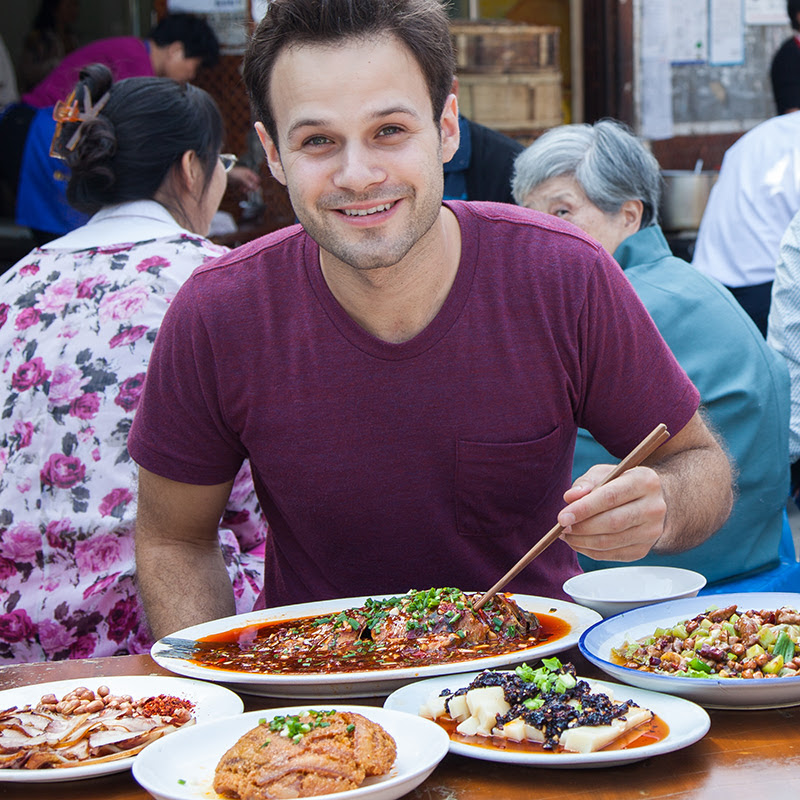
The core content strategy is exploring global cultures through street food, framed by unwavering optimism. James's stated mission is to counteract negative media portrayals of foreign countries. The niche is tightly focused on "deep street locations" and "hole-in-the-wall food joints," aiming to convey authentic discovery. A recurring content hook is the consumption of "unusual foods" — live coconut worms, rabbit heads, bull penis soup, camel platters — that reliably generates high viewership.
James's on-camera persona is a critical brand asset. His highly enthusiastic presentation is punctuated by signature catchphrases, most notably the Mandarin "Tai Hao Le!" ("It's great!"), and distinct sounds of culinary enjoyment. While these create a recognizable viewer experience, they've also become a source of audience criticism about authenticity. After years of constant travel, the operational strain became apparent. Between 2023 and 2024, James took a seven-month hiatus, attributing the break to feeling "a little tired" and needing to "recharge." He returned with a high-production series filmed in Kenya, framing the break as creative rejuvenation involving new passions like rock climbing and surfing.
How The Food Ranger Makes Money
The Food Ranger is a commercial operation with diversified revenue extending far beyond YouTube ads. A central pillar is a highly developed affiliate marketing program, built from the operational necessity of living in China. Circumventing the state's "Great Firewall" required a VPN, which James transformed into a lucrative revenue stream. He promotes providers like ExpressVPN through detailed guides and a secondary website, travelsecurely.com, functioning as a marketing funnel. Other affiliates: Epidemic Sound (music) and TubeBuddy (YouTube tools).
The brand operates a merchandise store on Bonfire.com, selling apparel with catchphrases like "SPICY," "Tai Hao Le," and "Travel, Eat, Repeat." Direct-to-business services are offered through a "Restaurant Promotion Kit" on his website. A Patreon account provides direct fan funding. The operation is professionalized through representation by Delka Talents, a macro-influencer agency working with clients like Coca-Cola and Tencent Games. The business inquiry email directs to a @delkatalents.com address.
The Food Ranger's Collaborations and Government Partnerships
The Food Ranger is a central node in the elite network of global food travel vloggers. James has filmed with Mark Wiens (Migrationology), Sonny Side (Best Ever Food Review Show), David Hoffmann (David's Been Here), and Wil Dasovich. During 2020 lockdowns, three of these influencers participated in a coordinated virtual "spicy noodle challenge" to maintain engagement.
His most significant partnership is a formal collaboration with the Malaysian government. Facilitated by the Ministry of Tourism, Arts and Culture (MOTAC), the "Ultimate Malaysian Road Trip" series generated immense publicity — one report citing 128 million views on Facebook alone. James was honored with a certificate of appreciation by Tourism Minister Datuk Seri Nancy Shukri. During this period, he and Ting Ting moved to Kuala Lumpur under the "Malaysia My Second Home Programme." Corporate sponsorships, like a deal with Mahan Air for flights in Iran, provide further support. On-the-ground operations depend on local fixers including Obed from Kumbukumbu Tours in Kenya and local vlogger Ruzaina Hadgie in Sri Lanka.
The Food Ranger's Controversies: Authenticity Questions and the Cockpit Incident
Public perception of The Food Ranger shows sharp contrasts. The brand's popularity is undeniable — millions of followers and official government commendations. But a vocal counter-narrative persists, centering on perceived lack of authenticity. Viewers frequently describe James's reactions as "fake" and "over-exaggerated," his content as formulaic, with limited vocabulary of praise and near-total absence of critical food reviews. The relentless positivity has led to speculation that it's a strategy to maintain access and receive free food.
This is overshadowed by a far more serious issue: a documented breach of international aviation security. In a video from his Iran series, James filmed himself inside the active cockpit of a Mahan Air flight while the aircraft was airborne. This is a violation of the sterile cockpit rule, a safety protocol established globally after the September 11, 2001, attacks to prohibit non-essential personnel from the flight deck.
The incident is compounded by its geopolitical context. Mahan Air is an Iranian carrier sanctioned by the United States for alleged logistical support of the Islamic Revolutionary Guard Corps (IRGC). Knowingly partnering with and promoting a sanctioned entity while engaging in high-risk activity on their aircraft exposes the brand to severe ethical and geopolitical scrutiny. For any potential partner with a compliance department, this incident is a significant red flag. Less severe criticisms include compromised editorial integrity (perfect "10/10" ratings for free food) and a vlogging style that some feel involves "shoving cameras in everyday people's faces."
The Food Ranger Today
The Food Ranger is a mature and profitable digital media brand, built on Trevor James's ability to create a powerful brand and shrewd business model. His optimistic messaging has secured a massive audience and high-value government partnerships. But the brand faces vulnerabilities: creator burnout (evidenced by the seven-month hiatus), content stagnation if it doesn't evolve beyond its formula, and the cockpit security breach, which remains a severe, unmitigated reputational liability that undermines the trustworthy image the brand depends on.