


About
The story of Sailing SV Delos is a multi-act drama of strategic evolution, transforming from one man's escape from the Seattle software industry into a resilient, crowd-funded global media enterprise. The project began not as a content play, but as a carefully planned departure from a conventional life. Over 15 years, it matured from a personal adventure into a family saga, cultivating a deeply loyal community and a diversified business model. Now, in its most ambitious phase, the Delos project is undertaking a multi-million dollar investment in a custom-built expedition vessel, Delos 2.0, designed to secure its next decade of high-latitude exploration and premium content. This is the account of how an engineer's four-year plan forged one of the most durable brands in the creator economy.
Sailing SV Delos: From Seattle Engineer to Ocean Voyager
The start of the voyage was a calculated rejection of the "house in the suburbs" lifestyle by founder Brian Trautman. A successful electrical engineer in Seattle, Washington, with a background that included climbing telephone poles and co-founding a software consulting firm with friends from Microsoft, Trautman found himself disenchanted with the 60-hour work week. Around 2005, he initiated a formal four-year plan to exit his career. This period was defined by systematic saving, the selling of all personal possessions, and the search for a vessel capable of true ocean crossings. His engineering background would prove to be a foundational asset, enabling the crew to perform their own maintenance and complex system upgrades—a critical factor in the project's long-term self-sufficiency.
The vessel he selected was a 53-foot Amel Super Maramu ketch, built in La Rochelle, France, in 2000. Already named Delos by its previous owner—a reference to the mythical Greek island sanctuary created by Poseidon—the boat was a significant capital investment that de-risked the project's early years. Its proven reliability allowed the focus to remain on the journey, which officially commenced from Seattle in August 2009 with a projected 18-month timeline to New Zealand.
The crew, and the narrative, began to evolve almost immediately. In March 2010, Brian's younger brother, Brady Trautman, joined in Mexico for what was meant to be a month-long passage. He would instead leave his Environmental Engineering studies to become a full-time crew member, his marketing and editing skills proving instrumental in the channel's early growth. After crossing the Pacific and arriving in New Zealand in October 2010, the next pivotal addition occurred in 2011. In Auckland, Brian met Karin Syrén, a Swedish native with a background in landscape architecture and no prior sailing experience. She joined for a weekend sail, became a permanent fixture, and eventually married Brian.
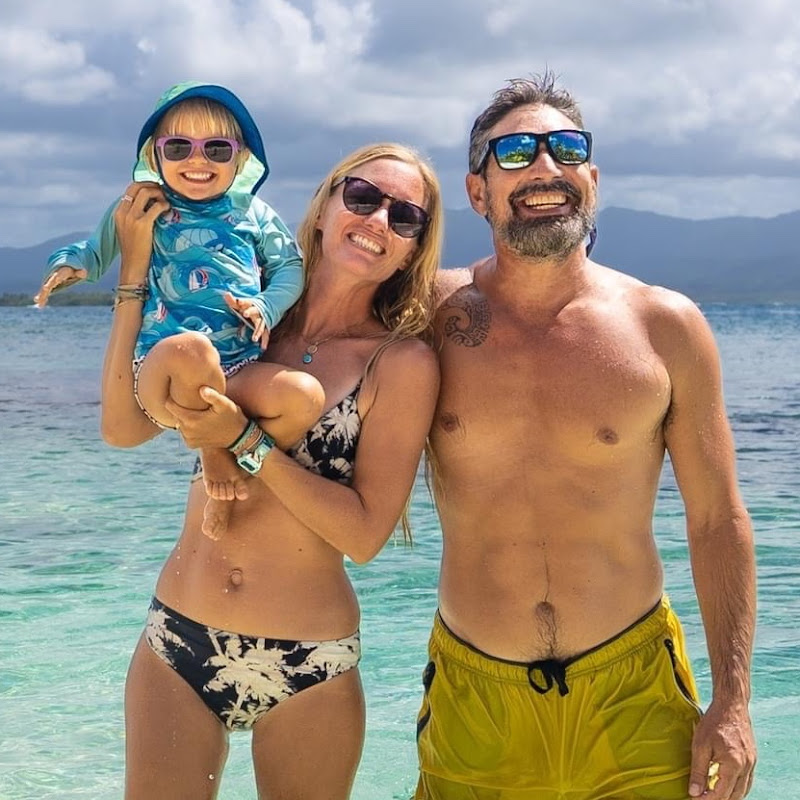
With funds depleted, the crew was forced to work for a year in Australia. It was here, out of necessity, that the idea to create videos was born. What began as a way to update family and friends soon professionalized. The journey continued through Southeast Asia, including an eight-month stay in the Philippines, before a challenging Indian Ocean crossing from 2015 to 2017 took them to the Andaman Islands, Chagos, and Madagascar. After extensive time in South Africa, they crossed the Atlantic, explored South America and the Caribbean, and completed a "North Atlantic Lap" that included a high-latitude expedition to Svalbard, Norway. The birth of their daughter, Sierra ("The Little Nugget"), marked the final major shift, introducing the theme of "family sailing" and serving as the primary catalyst for the construction of a new vessel designed for a family's future.
SV Delos: Content Pillars and the Rotating Crew Model
The Delos content engine was forged in Australia when a fellow sailor suggested they document their travels on video. Starting with a small camcorder, the project quickly scaled, adopting a weekly production schedule and investing in professional equipment. Video production became a shared responsibility among the core crew, ensuring consistent, high-quality output.
Their strategy is built on distinct content pillars serving a broad audience. Travel and Adventure: cinematic documentation of ocean passages and exploration of remote destinations from the Tuamotus to Namibia. Technical and Educational: leveraging Brian Trautman's engineering skills, these videos detail complex repairs and system upgrades, providing direct value to boat owners and establishing the channel's credibility. Lifestyle and Personal Vlogs: a behind-the-scenes view of crew dynamics and the realities of life at sea—including raising a child on board—fostering deep personal connection with viewers. Long-Form Documentaries: the premium, four-part docu-series "80 North," documenting their voyage to Svalbard, signaled an evolution beyond ad-supported YouTube toward direct media distribution.
A distinctive feature is the open and rotating crew model. Over its history, Delos has hosted more than 50 different individuals. This keeps the narrative fresh and reinforces a message of inclusive community, powerfully realized through Patreon-based crew contests where high-tier supporters can win a spot on the boat.
SV Delos: A Multi-Layered Revenue Model
SV Delos operates a diversified, multi-layered monetization system. The financial core is its Patreon community, "The Delos Tribe," whose members provide direct, per-video financial contributions, creating a predictable revenue stream. A creatively tiered reward system with nautically-themed names—"Swab," "Mate," "Pirate," "Blackbeard," and "Greybeard"—incentivizes increasing levels of support. While reports from 2019 suggested earnings of approximately $14,000 per video, a 2025 analysis indicates a total monthly income of around $17,500 from all sources, with remarkably low average monthly operating expenses of $1,900.
Beyond Patreon, the enterprise is supported by several other revenue streams. Corporate Sponsorships: high-profile partnerships with marine brands like VETUS and Nanni provide large-scale capital and in-kind contributions, particularly for the Delos 2.0 build. Other sponsors include NordVPN and BetterHelp. Merchandise Sales: an online store selling branded apparel and accessories. Affiliate Marketing: an Amazon Storefront featuring recommended cruising essentials. Direct Content Sales: the "80 North" docu-series was sold using a "Pay What's Fair" model, bypassing platform fees to maximize revenue. YouTube Ad Revenue: standard ad income provides a supplemental revenue source.
Sailing SV Delos: Crew Network and Industry Partnerships
The core network of SV Delos is its evolving crew. Led by Brian Trautman and Karin Syrén, it has included key long-term members like Brady Trautman and his partner, Alex Blue, who have since gone on to found the Cruisers Academy to teach sailing. The project has also attracted numerous corporate collaborations, particularly for the Delos 2.0 build, featuring deep partnerships with VETUS, Nanni, and Rutgerson Marin. While often mentioned alongside other leading sailing channels like Sailing La Vagabonde and Gone with the Wynns, direct on-screen collaborations with these peers are not a prominent feature of their content.
SV Delos: Media Recognition and Public Scrutiny
SV Delos is widely regarded as a pioneering YouTube sailing channel, featured in major publications like Yachting World, SAIL Magazine, and Cruising World. This high profile has also attracted scrutiny. One common point of discussion among long-time followers is the channel's evolution from a freewheeling atmosphere with a rotating cast to a more settled, family-focused narrative. While this may have alienated a segment of the original audience, it represents a strategic maturation that opened the brand to a broader demographic.
The Delos 2.0 build has attracted scrutiny on public forums like Reddit, where users have questioned certain engineering choices and speculated about potential issues, such as the acoustics of an uninsulated aluminum hull. These critiques remain speculative. Over its long history, the crew has also been the target of online rumors. One rumor linking the crew to a death was investigated and debunked as a case of mistaken identity. Another allegation, found in a single unverified comment on an old blog post, claims that an early crew member, Erin Russ, was "erased" from the project's history; no corroborating evidence supports this. The project has also faced real-world challenges, including a near-detention of their vessel in French Polynesia over an import-tax deadline.
SV Delos: Philanthropy
The Delos brand is reinforced through tangible philanthropic action. The crew has leveraged their platform for charitable causes, notably generating over $15,000 for hurricane relief in Dominica by matching community donations. In 2019, they also donated $50,000 to various charities, including the ocean conservation group Surfrider Foundation.
Sailing SV Delos Today
The SV Delos project is currently defined by the design and construction of Delos 2.0, a custom Delos Explorer 53 catamaran being built from 5083 aluminum alloy by Stradbroke Yachts in Brisbane, Australia. Featuring a hybrid-electric propulsion system, a 3,750-watt solar array, and a protected internal helm, the vessel is the direct result of 15 years of cruising experience—driven by the shift to a family dynamic and ambitions for Arctic and Antarctic exploration. The build, with a planned launch in early 2026, is being documented as a major multi-year content series that strategically positions the SV Delos brand at the premium end of the creator market.