




About
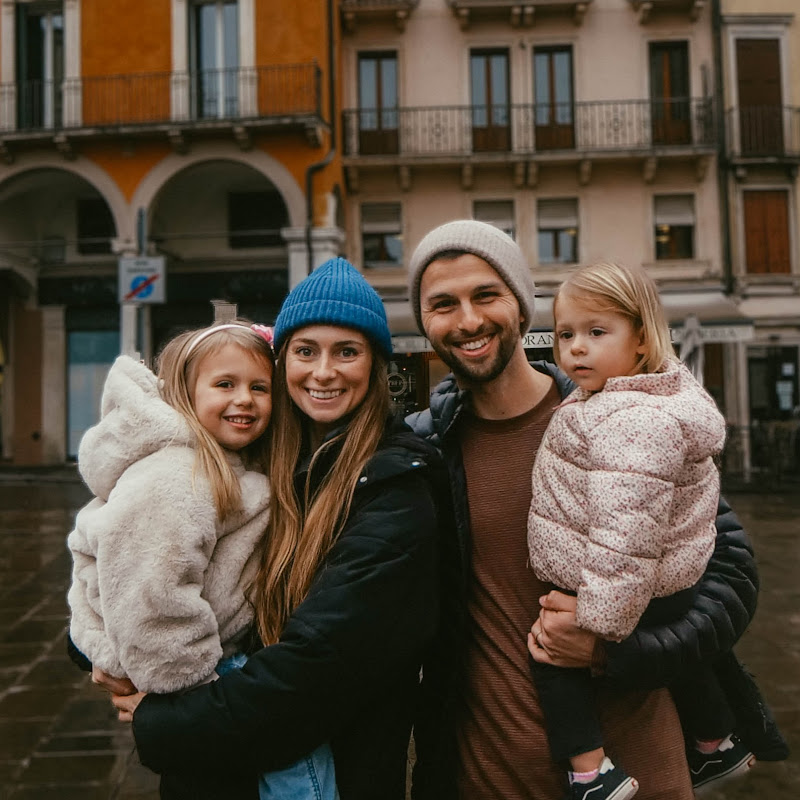
On 9 April 2021, Tanner and Risa Christensen filmed themselves out of arrival quarantine in Grafenwöhr, in Bavaria's Upper Palatinate, beside a U.S. Army training area. With their daughter Willa, that posting turned Our Story to Tell into the regular diary of an American family overseas on Tanner's civilian health-and-safety work. The jobs have taken them from a very small Bavarian village to Yokosuka, on Tokyo Bay, and then to the Vicenza area of northern Italy, where Noa, born in Germany, is growing up with her sister. Tanner has described the years abroad as temporary and visa-based, tied to his U.S. government work. The films stay with food, prices, schools, the labor of each move, and the trips that start once a posting feels livable.
A Mission, a December Wedding, a Name From a Song
Both describe a late-1990s and early-2000s childhood in a small, conservative Latter-day Saint farming community in northern Utah. Risa was born and raised in Idaho and Utah and has said she moved from southern Idaho around age 12. Tanner was born and raised in Utah. They met in middle school and high school, call themselves high-school sweethearts, and on Instagram have called themselves "poster children" of that community, a chicken-farm job among the memories they like less. They were active in the church, including early-morning temple baptisms. Tanner has said both have English ancestry, and that Christensen comes from Danish ancestors who immigrated in the early to mid-1800s.
Less than a month after high school, at 18, Tanner left on a two-year mission for the Church of Jesus Christ of Latter-day Saints, split fairly evenly between El Salvador and Belize. He has described the work as full-time teaching and returned in June 2015. During his first year away, Risa finished high school, then spent her freshman year at Utah State University in Logan, starting prerequisites to become a registered dietitian and working side jobs. They wrote through those two years, became engaged about two months after he came home, and married in mid-December 2015, when she was 19 and he was 20. They were sealed in the Logan Utah Temple. They say they married while still in college and attended university together.
On the channel and in interviews she goes by Risa. Older posts, her dietetics work, and the nonprofit she cofounded use Marisa. The YouTube channel was created on 21 January 2016. Risa has said the name arrived while she was driving, from a song that used the phrase "our story to tell," because she wanted a title that could follow the family anywhere. An April 2021 reintroduction looks back at early Utah films: hot springs, a polar plunge, hot-air balloons, a lantern festival, and restaurant tests. In an August 2025 conversation with Live in Italy Magazine, they described the channel as a family diary that began in Germany. The 2016 date and the Utah films come first. Germany is when the uploads settled into a regular expat diary. By July 2021 the pace had dropped from two videos a week to at least one Sunday film, with an occasional extra, and a Wednesday surprise still appears sometimes. Risa does most of the editing. They choose ideas and titles together, and Tanner handles descriptions, links, and subtitles. They say they film mostly while traveling, keep some days camera-free, and rarely film at home, so the girls can be on camera while the rest of family life stays off it.
Two Backpacks, Then a Practice She Closed
After college Risa became a registered dietitian and a personal trainer. Tanner finished an internship he has identified with Boeing and has described his degree as public health. At the end of that internship and his courses they led a humanitarian trip to India with 18 volunteers, then kept traveling. Their accounts of the length differ: about four months in Southeast Asia plus time in Australia and New Zealand, "about half a year," five months, or six months. Countries they name include India, Sri Lanka, Myanmar, Malaysia, Indonesia, Vietnam, Cambodia, Thailand, Australia, and New Zealand, and in one video they mention stepping into Tahiti. They have written that they lived out of two backpacks, slept in inexpensive hotels, and road-tripped in a small yellow car. Risa had earlier traveled to Thailand on her own. Tanner's first trips outside the United States were the mission and a later trip to Belize with Risa. Both had camped and visited U.S. national parks as children.
They say the long trip changed them and that Utah afterward felt small. They bought a first house, and Risa opened a private dietetics practice, which she has called her dream. She has said she worked with people with eating disorders and disordered exercise, and she wrote the recipe book FRESH & FAST: Delicious, Healthy, Kid-Friendly Meals You Can Have On the Table Quickly, along with free recipes and nutrition articles. Tanner's first full-time job was at Hill Air Force Base in Utah. He has said he worked there about two years, and that they learned Risa was pregnant a few days before he started. Willa was born during that first year. A December 2020 video marks her first birthday and a first real Christmas tree in that house.
Nutrition Education Ending Malnutrition, or NEEM, a 501(c)(3) linked from the channel, began in a university class where Marisa learned about malnutrition in India. She and Tanner founded it around education, with volunteer programs that have included India, Indonesia, and Utah. A public filing lists Marisa Christensen as chairman and places the organization in Tremonton, Utah. The founders' letter is signed "Marisa & Tanner Christensen." International living, they say, was a lifelong dream that became concrete after the backpacking, and Tanner has said the move was for his job. Risa closed the practice to go. "That was my dream and I left it behind to chase your dreams abroad," she has said. They also left family, a house, and what they call a comfortable Utah bubble. In 2022, looking back from Germany while still in their mid-20s, they described an active life and an intuitive-eating approach and said they did not own a scale.
Grafenwöhr, Then a Village of Six Houses
A 12 September 2021 video calls the stay six months old. One year is marked on 6 April 2022, and on 5 March 2023 they said they had been in Germany 730 days. A goodbye on 17 December 2023 says they were leaving after about two and a half years. On a March 2026 podcast they counted five years since leaving the United States. The dated films place arrival in early spring 2021 and departure in December 2023.
Tanner worked as a civilian health and safety officer in industrial hygiene for the U.S. Army. After temporary housing in Grafenwöhr they lived in a very small village in the Bavarian countryside, a short drive from the base. At one point they described it as "six houses." In 2021 they were still looking at houses under construction. Willa started German Kita around age two, which they credit with drawing the family into the community. They were on the German health system. Noa was born there in an unassisted home birth in which Tanner caught the baby, told in a video and in a post dated 18 April 2023. They tell it as intense and, in their words, spiritual. They say she has a German birth certificate and was about six months old when they moved to Japan.
Trips from that base fill much of the Germany period: Iceland, Greece, Croatia, the Dolomites, the Bavarian Alps, Sicily including Palermo, and a Scandinavia van trip through Norway, Sweden, and Denmark, alongside bakeries, Christmas markets, supermarket shops, and regional dishes. Within the first six months, they have said, someone stole a backpack in Croatia. In November 2021 they flew home after Risa's uncle died unexpectedly, then returned. In a September 2021 video, missing the NEEM work, they asked viewers for service ideas they might try in Germany. The one-year video mentions driving and parking tickets, recycling, language, and life in a military town. Nude sauna culture, Sunday quiet, and grocery shopping were among the early shocks. By the end they called Germany pivotal: distance from family and from Utah, time to think, and the start of questions about the religion they were raised in. The December goodbye is openly sad about friends and the feeling of home. They have said the next post was how they could stay abroad. Tanner's remaining window for overseas work made Japan that post, and they expected about two and a half years there.
In the April 2022 one-year video they wrote that they were shocked to have reached 20,000 subscribers. From there the audience rose to about 43,600 by 28 October 2026, after holding near 43,000 through 2025 and 2026. The 12 May 2021 film "NO SPEED LIMITS on the German Autobahn?!" is the one that traveled farthest, at about half a million views.
Twelve Months South of Tokyo
On 22 October 2023 they announced a move to Yokosuka, south of Tokyo, citing a city population of about 406,000. Orders had wanted them in late September or on 1 October. They pushed the date and expected to leave Germany before the end of 2023. A first-week video is dated 7 January 2024. A coworker drove them from the airport to the naval base at the south end of Tokyo Bay. Tanner has said the Japan job differed from the Army role in Germany. They lived about an hour south of Tokyo and described the shift from a tiny village to a dense, hilly city.
They had expected about two and a half years. They stayed about twelve months. They say they loved Japan and also found the move hard, especially for Willa, who attended a local yōchien. They traveled in Japan, including Hokkaido and a Mount Fuji hike with Risa's sister, camped at several sites, and went to South Korea and Taiwan. Food, vending machines, and daily life sit beside those trips. They have said they were naive about three country moves in about four years with small children: schools, childcare, and sleep. A 12 January 2025 video, "WE'RE MOVING TO ITALY," says the plan had been in motion since mid-June and that they had already landed at Venice Marco Polo, which they called the first European airport they had ever used. They called the exit bittersweet. The reason they gave was another job, one that would extend their time overseas and return them to Europe, which they missed.
The Questions That Started in Germany
The travel films stay with trips, food, and family logistics. In October 2025 they started a video podcast, also called Our Story to Tell, for the personal story under the moves. It opened on 5 October 2025 with "How Leaving the USA Changed Everything," then ran roughly every two weeks on YouTube, Spotify, and Apple Podcasts, about 15 episodes, from childhood and the backpacking years through the three countries, beauty culture in Utah, and raising children abroad.
They describe growing up inside a devout Latter-day Saint world and, over more than three and a half years abroad, re-examining what they had been taught. They name church-history essays, accounts of the First Vision and of Book of Mormon translation, polygamy, church finances, abuse cases, garments, and LGBTQ questions among the issues that unsettled them. They say the questions started in Germany while they were trying to strengthen their faith, after they noticed how different German family life felt. Near the end of the Germany years Risa told Tanner she could not see herself continuing in the church in the same way. They describe a trip in Norway as a moment of letting an older version of themselves go. A couple of months before leaving Japan, they say, they said aloud that they no longer wanted to be part of the Mormon faith. They call the first year in Italy a "reconstruction," lived without organized religion and with new family traditions. They describe that change as painful and also grounding.
Early 2026 episodes made the story public, including "Our Mormon Faith Shift," around January, "Why We Left the Mormon Church" on 8 February, and "Our Religious Reconstruction After Leaving Mormonism" on 22 February. They frame the episodes as their own experience and ask believing listeners to skip them if the material feels unsafe. Many comments, they say, were kind. Some people shared why they stayed, and some criticized the decision. Their line in the episode disclaimer: "the world became too big, too diverse, and too beautiful to fit inside that box anymore." On 26 and 27 April 2026, in "Raising Kids Abroad," they said that episode would be the last for the foreseeable future. The show took more time than the travel videos. They wanted the hours for the family, planned to keep a travel film about every other week, and said they might return to the podcast later.
First Grade, Then a Summer of Visitors
They live in the Vicenza area of Veneto. Tanner has said the job chose the place. As of the August 2025 interview, he described the work as a civilian U.S. military health-and-safety role, on a three-year contract with a possible two-year extension. They like the mix of mountains and sea, Venice's airport about an hour away, and easy trips back toward Germany. Beside Yokosuka's roughly 400,000 people, they called Vicenza smaller and still sizable, with smaller communities around it. House-hunting took longer than in Germany and less time than in Japan. They say they looked at about six houses. For a period they stayed in a hotel on the U.S. Army base and drove Willa to a local school, wanting her in Italian as soon as possible. They say she started in February.
In that interview they said they would like to stay as the girls learn the language, and that after the contract another European post or a return to the United States would depend on the work. They hope the girls grow up curious about other people and feel free to choose a conventional life or an adventurous one. What they miss in the United States is family, and small conveniences such as air conditioning and ice. Tanner misses handling errands without preparing vocabulary. In the United States they miss walkable cities, trains, and markets. An August 2025 film about a trip home talks about reverse culture shock, including how many people wear baseball caps in Utah. They also camped in the Austrian Alps in 2025. In a December photo recap they marked ten years of marriage in Verona, which they called the hometown of Romeo and Juliet, along with a unicorn party for their six-year-old and a year since leaving Japan.
By March 2026 they said the first year in Italy was done. By September 2026 they had lived there more than a year and a half. Willa completed first grade in the Italian system in June 2026, and both girls have been in local school or childcare. Tanner's Spanish from the mission is something he uses while learning Italian. A May 2026 video checks their Italian after about a year. They say Willa picks the language up faster than they do, sometimes without a noticeable American accent. Italy films through that year take in Padua, the Euganean Hills, Verona, Venice, the Dolomites, including a via ferrata and a night in a rifugio, Lake Garda's Christmas markets, Trieste and Piran in Slovenia, a multi-part Sardinia trip with a food tour, and Parmigiano Reggiano, Prosciutto di Parma, and balsamic vinegar.
Summer 2026 was organized around visitors from the United States, especially Risa's family, with other relatives and friends along: Plitvice, a cave zipline, Rovinj, and Pula in Croatia, more of the Italy they wanted guests to see, and a Swiss Alps trip with via ferrata, fondue, and hiking. That Alps film went up on 18 October 2026. The podcast stayed on pause, travel videos continued about every other week, and the contract Tanner described in 2025 still had years to run.
Products
No products yet
Our Story to Tell hasn’t published any products yet. Check back soon!
Travel Insights
No Travel Insights yet
Our Story to Tell hasn’t shared any Travel Insights yet. Stay tuned!