



About
On 15 November 2016 Lucy Pinnell and Ben Fuery opened From Rust to Roadtrip. They were already months into a trip in a rusty 2002 LDV Convoy that they had pictured as a summer holiday, and the channel became their record of frugal van travel, wild hot springs and slow films about places and the people in them. Lucy does most of the writing, Ben directs and edits, and both photograph. They call themselves partners in the work and in the life, and they keep that word on purpose. The same work later put them on camera for NHK, in a hot-spring series they say reached millions of viewers in Japan.
A lecture in Truro, then cash in Banbury
Lucy was born in Cornwall. She has said she moved to France at eight and came back to England at fifteen, and that the move, then the unsettlement of returning, turned her toward travel. At fifteen, by her own account in 2018, she decided a life of about eighty years had better be used, and she began to want a campervan. She took A-levels at Truro College in photography, English, French and Italian. She has since specified that English A-level as English Literature and Language, and has said her dissertation, Photography in Contemporary Culture, received top grades. Encouraged by the college, she stayed for an Action Photography degree at University Centre Truro and Penwith and graduated in 2015. A longer aim she has named is human-interest work of the National Geographic kind, or filmmaking for a charity.
Ben has said he comes from just outside London, moved to Cornwall as a child, and lost count of the houses he lived in. He ties those moves to an appetite for new places and a search for belonging. Interviewed by These Rolling Hills in January 2018, the couple still answered that they were both from Cornwall. The London childhood is the account he gave later. He took the same course. They met on it in 2013, stayed friends through the two years, and became a couple around graduation in 2015. Lucy has said she walked into the first lecture performing a confidence she did not feel, and that the act convinced Ben too. In February 2021 they wrote that they had been mates for seven years and partners for five, and that they were the only two students to graduate the course.
Ben had already backpacked in India and Eastern Europe. India at eighteen was, he says, the first big trip: a phone fell from a glassless train window, he sat on his tablet, and a Lonely Planet became the map. He had worked as a chef, and when university ended he was planning to go alone through the Middle East and the Stan countries. Lucy had run her own Airbnb and wanted more of Europe. In their telling the two plans met in a van. Ben had always liked the LDV Convoy from old British films, and a friend of a friend was selling one.
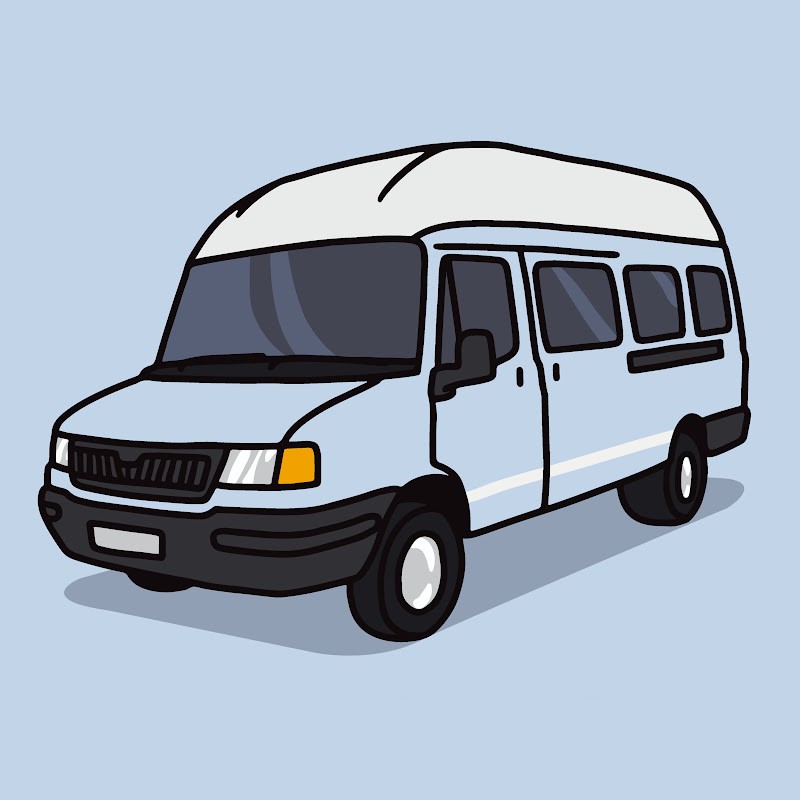
After graduating in 2015 they worked the summer, took a train to Banbury and paid £1,000 cash for a 2002 ex-minibus. They have described it as rusty, leaky and covered in tie-dye, a broom handle holding the roof up, with used knickers and tins of German stew in the back. Ben had no driving licence, so Lucy drove it home to Cornwall. They knew almost nothing about DIY. Writing in February 2021 they put the conversion at ten months; a later interview with Robie Robes put it at eight. Using their figures, the Daily Mail reported a build of about £5,000 in November 2019, much of it reclaimed: a £14 bed, a £20 secondhand fridge, a £70 diesel heater and an £80, 100-watt solar panel among it. Off the grid, the van could cook, heat, shower and run a toilet. They sometimes called it Colin, because it leaked like a colander, and never really settled on a name.
The holiday that would not end
They left England in 2016, bound for a long summer through France, Spain and Portugal. It ran to about eight months. Early on, Ben nearly bought a flight home. In Porto, on a side street by their account, someone smashed a window and took their belongings. They nearly abandoned the journey, patched the glass with help from friends, and went on through Italy and the Alps in midwinter, camping on nights down to minus 10°C. They treat that choice as the turn. After it, going home stopped being the plan.
What followed is their own account, and it was seasonal. Summers, roughly half the year, were for working in Britain, sometimes in 60-hour weeks, while they lived in the van and paid almost nothing in rent or bills. The savings bought seven or eight months on the road, until the money ran out. In February 2018 they put road costs at about £420 a month and said a house in Britain was out of reach on their income. A film in February 2020 put the day at £20, sometimes as low as £400 a month when they drove less, most of it diesel and vegetarian food they cooked, with no campsite fees and about 25 miles to the gallon. Lucy said then that the Airbnb was behind her. She told the Daily Mail in 2019 a line they still echo: "Our life on the road to us feels like we are living our real lives… whereas when we're back in the UK it feels like our lives are on hold."
The first videos, they have said, were awkward pieces to camera. Lucy calls the form cinematic vlogs, or mini travel documentaries. Self-taught, they date the travelogues to 2017 and describe a slow move toward researched films led by a place. One of them travelled much further than the rest: "NATURAL HOT SPRINGS in the Pyrenees!", published on 16 July 2018, with about 547,000 views by June 2026. A Truro College alumni page written after the 2021 television commission put the channel above 12,000 followers. On 24 October 2026 it stood at about 18,400 subscribers, roughly 1.5 million views and 199 videos. Television licensing, they have said, later kept much of their footage off the public channel, which is part of why the uploads went quiet for long stretches while they were still filming.
Springs, snow and the photo essays
At Saturnia, in Tuscany, they soaked for a week, as often as five times a day. Lucy's line, recalled later, was: "It's like sitting in a river, but hot!" For a long time the van had no heater, so a spring was warmth as well as a subject. On the second European journey they routed by water and bathed in about a dozen springs across eighteen countries, taking temperatures and writing them up. By a 2023 interview they had passed 70, with hundreds more marked, including hopes as far as the Russian Far East and Greenland. By October 2026 they were putting the number above 100. They have also said that publishing an exact spot can harm a spring and the people around it, and that some have closed through neglect or crowds, so they grew careful about coordinates.
Writing in February 2018, after 13 months on that leg and 20 countries, they described running from snow, a hike in the Albanian Alps to families who fed them mountain food and raki, thermal pools above 40°C in Bulgaria and Greece, and a week wild-camping in Romania's Făgăraș, bathing in a stream and cooking on a fire. The mission, as they put it, was every country in Europe and beyond. Van life was a choice, and also their answer to the cost of housing in Britain. Beside the films they published photo essays: Outlands, on remote Albania in 2018, and Outlands II in 2020; Csikós of the Síkság, on Hungarian horse herdsmen, in 2019; Fringes, on Roma settlers in Romania, the same year; Hermitage, still ongoing; and Transient, about intimacy and endurance on the road. A guide led them up a near-vertical Albanian face to a homestead at about 1,200 metres, with no way in for a vehicle. The woman there told them a wood stove had taken her and her husband three hours and a mule. In November 2019 the Daily Mail and The Sun, giving Ben as 26 and Lucy as 24 and placing the couple in Hayle, reported 25 countries, east to Ukraine and south to Greece.
A month to make the Convoy run
By 2020, they have said, the spring hunt had become an obsession. They logged another thirteen springs across twelve countries and drove back to Britain before the borders closed. The Convoy was in such bad shape they thought it might never drive again, and that year they treated it as retired. In September Lucy took Ben tent-camping in Snowdonia in her old Volkswagen Polo, a return to the way they had camped as students. They later made a point of seeing British national parks they had put on stickers and never visited: the Lake District, the Peak District, the Yorkshire Dales.
In December a producer who had found the blog emailed, wanting them not only as researchers but on camera, presenting and filming. They had a month to put the Convoy back on the road. With T Media Lab they researched, presented and co-filmed Europe Hidden Hot Spring Journey for NHK. The credits name Ben Fuery and Lucy Pinnell as presenter, researcher and videographer, and they say the programmes reached millions on NHK's general and BS channels and on Amazon Prime Video Japan. They count four series. The run includes France and Italy, then Albania and Greece, aired 30 November 2021, which NHK described as two young Britons, a camper wagon, about 5,000 kilometres and 50 days. Later episodes covered Slovakia, Hungary and Romania on 17 December 2022, Serbia, Bulgaria and Turkey on 31 January 2023, Spain, Portugal and the Azores, Iceland, and a Switzerland film first broadcast on 13 August 2026. By February 2021 they were reporting 28 countries over four years. In March 2022 they wrote that 60,000 miles and those 28 countries had still left them knowing woefully little of their own.
Turkey, Bowie, and a cargo ship
In six years on the road, they wrote, they had rarely been apart for more than a few days. In the winter of 2022 Ben took four weeks catering at the Beijing Winter Olympics. His diary for 19 January says he left Cornwall by train, that his foot had swollen the day before, and that a PCR test came back positive. Lucy used the gap for a first solo trip, to Israel, including Jerusalem, and wrote "At Two Ends of the Same Continent."
On 9 December 2022, a month into a first visit, Turkish news agencies interviewed them in Eskişehir and quoted a couple in love with the country after Istanbul, Bursa, Pamukkale and Eskişehir, heading for Cappadocia and the east, then Georgia, Armenia, Azerbaijan, Kazakhstan, Uzbekistan and Kyrgyzstan. The same reports gave six years, 29 countries, more than 50 national parks and 160,000 kilometres, about 100,000 miles, and ages of 29 and 27. Set beside the ages of 26 and 24 in the British papers of November 2019, that lines up with Ben born in late 1992 or 1993 and Lucy in late 1994 or 1995.
Lucy's February 2023 essay on eastern Turkey describes Kurdish and Armenian highlands, daily offers of bread, tea and a place to stay, and drivers who scanned a QR code on the van to welcome them. The winter nearly ended the journey twice on ice. They have said they thought the van might slide off the mountain with them or without them. It was still two-wheel drive. In Georgia they bought a small wood stove for £20 and paid £3 for a flue plate after hitting minus 11°C in eastern Turkey. Later, in the Caucasus, they recorded minus 22°C. Someone chopped firewood and refused payment. In a 2026 interview they set a bright, rainy sunset on a Bulgarian hill, after eight months through Turkey and the Caucasus, as the moment that winter felt survived. Films of the drive home carry the title of a 5,000-kilometre journey from Armenia to England.
In Armenia they found orphaned street puppies. One, too weak, died after vaccination, and they have written that plainly. The survivor, Bowie, had to wait on rabies rules. A blood sample sent from Armenia to a laboratory in Russia broke in transit, and they describe delays of more than four months, partly because of the war in Ukraine. One of them flew back about seven months after the rescue to collect him. An April 2024 TikTok said a year had passed since the puppies were found, which puts the rescue in about 2023. Their November 2024 essay is the practical account of that paperwork, with thanks to the shelter dog_shelter.21 and to donors.
In February 2024 there was no passenger ferry from mainland Portugal, so they put the Convoy on a cargo ship at Lisbon's Santa Apolónia terminal and flew to São Miguel. They itemised the move at €7,105.93. The van sailed on the open deck, arrived salty and intact, and in their telling the sea air hurried the rust. They believed they were the only foreign campervan on the island, and certainly the only LDV, and that São Miguel offered no onward ferry. Furnas was the place that held them. They have called São Miguel the westernmost point they reached in that van, Santorini the southernmost, and Ukraine, Georgia and Armenia the eastern edge.
The clutch, then India's Land's End
Over the winter of 2025 and 2026 they reached the Faroe Islands after two days at sea on a ferry they clocked at about 13 miles an hour, then Iceland, to film another NHK episode. In Germany, with 48 hours until a Denmark-to-Iceland sailing and a bank-holiday weekend in the way, the clutch failed. A friend opened a workshop. None of them had changed a clutch before. They worked about 26 hours, missed the ferry, and still made the island. They bathed at the Earth Lagoon at Mývatn, filmed there before the public arrived, and watched the aurora from a campsite. Lucy kept a weekly Substack, The Wayside Diaries, through Central Europe and Iceland. A Facebook post on 21 December 2025 placed them in Iceland and called the moss chapter the diary's last. Licensing kept the television pictures off a straight YouTube cut, so in 2026 they posted a behind-the-scenes account instead.
On the island they decided the Convoy was finished. The chassis was splitting, panels had cracked, and pieces fell off when the door shut. A diary line Lucy has read on camera runs: "goodbye rust bucket with no name. I hate you. I love you." Looking back that June, they counted two fuel pumps, five starter motors, six master cylinders, replacement panels, duct tape and an umbrella stand. When they bought it, they say, thousands of Convoys were still on the road. By the end, a handful were left. The country counts they have given climbed with the years: 28 by February 2021 and again in March 2022, 29 in the Turkish interviews, 32 in the Robie Robes conversation looking back over about a decade from 2013, and 34 by 2026. Mileage moved the same way, from 60,000 miles in March 2022 to about 100,000 in Turkey, then, once the odometer had stopped, a June 2026 guess of probably more than 150,000, beside an October figure of more than 100,000 from Cornwall.
Money kept cutting short the attempt to travel full time, so in 2018 they bought a second van: a 1979 Bedford CF, found in a barn in north Cornwall after at least two years idle, for £450 cash. The plan was to restore it, build a living-space box and hire it out in Cornwall. Lucy's father, who has mechanical experience, helped them restart the 2.3-litre slant-four. By the February 2021 welcome essay the project was three and a half years old. On 1 January 2023 they wrote that the restoration had reached the point of welcoming guests, and that a third van was already on the drive.
That third vehicle is a 1988 Freight Rover Sherpa, which they call the Convoy's grandfather. They trace the idea to Phil Llewellin's The Road to Muckle Flugga and to a Sherpa driven from Britain toward the Himalayas in 1978, and they date their own project to 2021. The search took them about twelve hours from Cornwall to Birmingham, where a fuel leak sent them home. A week later they drove back and bought it. The interior they stripped still had its 1980s carpet. They handed a bespoke 4x4 conversion to a workshop in Cornwall. By their account the deadline was September 2024. That December, three months past the date, they say they had had enough. A film published on 28 May 2025, "From dream van to disaster", and further films in July 2026, tell the rest in their words: about 18 months, thousands of pounds gone, labour they considered overcharged, parts missing, the van left dismantled in the Cornish rain. They took it back and nearly dropped the dream. They have called the experience being substantially ripped off, and have said they told it because other people described similar builds.
Through 2026 they restarted the work themselves in Cornwall. The Sherpa is to go onto Land Rover running gear, the original O-series petrol engine swapped for a 1994 Land Rover 300Tdi, chosen for mechanical injection, few electronics and parts that exist widely. An August 2026 post has the engine being rebuilt with one of their fathers. In a July 2026 interview one of them said a mechanic father still talks them through breakdowns by phone, and that their real training is roadside bush mechanics. The journey they describe, still being finalised, runs from Land's End in Cornwall to Kanyakumari, also called Cape Comorin, in Tamil Nadu, which they call India's Land's End: about 15,000 miles and, in one description, 19 countries, by way of Europe, Turkey, the Caucasus and Central Asia, then Pakistan, with Turkmenistan if they are lucky. They have set aside the 1970s route through Iran and Afghanistan. They hope the drive becomes their first feature-length documentary. On 23 July 2026 they gave that interview from Cornwall, the Sherpa still an empty shell and the layout undecided. By autumn they were rebuilding it in public under the series title The Sherpa Project, the LDV retired on the drive, and the road ahead still pointed at India.
Products
No products yet
From Rust to Roadtrip hasn’t published any products yet. Check back soon!
Travel Insights
No Travel Insights yet
From Rust to Roadtrip hasn’t shared any Travel Insights yet. Stay tuned!