

TrekGuider @trekguider
St. Patrick's: River Dyeing Secrets

You’ve seen the photos, and they look impossible: a major American river, flowing through a canyon of skyscrapers, glowing with the emerald-green hue of a shamrock. It’s a spectacle so surreal it feels like a clever digital edit. But it’s real, and the biggest problem for any traveler is that witnessing this world-famous tradition feels like a logistical nightmare. Where are the best spots? What time do you really need to arrive to beat the hundreds of thousands of spectators? And how do they even accomplish this magical feat without creating an environmental disaster?
Without a rock-solid plan, you risk being swallowed by a sea of green, craning your neck for a sliver of water between a thousand heads, only to miss the fleeting moment of transformation. You could spend hours shivering in the Windy City's notorious March air and leave with nothing but a blurry photo and the bitter taste of disappointment. This iconic event is the dazzling centerpiece of the city's festive calendar, a unique urban ritual that we place in the broader context of the city's year-round celebrations in our complete guide to Chicago Holidays: Windy City Thrills. Don't let poor planning rob you of the magic.
This is your definitive insider’s guide. Forget the guesswork. We are pulling back the curtain on the river dyeing secrets, from the history and science behind the tradition to a minute-by-minute game plan for a perfect day. You will learn the absolute best viewing locations, the parade navigation hacks locals swear by, and how to transform a potentially chaotic day into an unforgettable urban adventure.
The Legend of the Green River: An Accidental Tradition
While Chicago’s St. Patrick's Day Parade is one of the nation's oldest, with roots stretching back to 1843, the tradition that truly puts it on the global map is much younger. The practice of dyeing the Chicago River green was born in 1962 from a moment of pure, serendipitous observation. Stephen Bailey, then the business manager of the Chicago Journeymen Plumbers Local Union, noticed that a dye plumbers used to detect leaks and pollution sources in the river had stained a worker's white overalls a perfect, brilliant shade of Irish green.
A lightbulb went off. If that small amount of dye could stain fabric so vividly, what could a larger quantity do to the entire Chicago River? The Plumbers Union, a key sponsor of the parade, decided to find out. For the inaugural dyeing, they released 100 pounds of the chemical into the river, which, to their astonishment, kept the waterway a radiant green for nearly a week. The spectacle was an instant sensation, captivating the city and cementing a new, indelible tradition. Over the decades, the process has been perfected and the formula made environmentally safe, but the magic—and the stewardship of the event—remains firmly in the hands of the Plumbers Union, proof of a quirky idea that became a beloved civic institution.
The Science of the Spectacle: How Orange Powder Turns a River Green
The most closely guarded secret in Chicago isn't a political backroom deal; it's the precise formula for the dye that transforms the river. What we do know is that it’s a vegetable-based powder, making it completely safe for the river's ecosystem. The real visual trickery, however, lies in its color. When you see the crew on the boats scooping the substance from its container, you’ll notice it’s a bright, fiery orange.
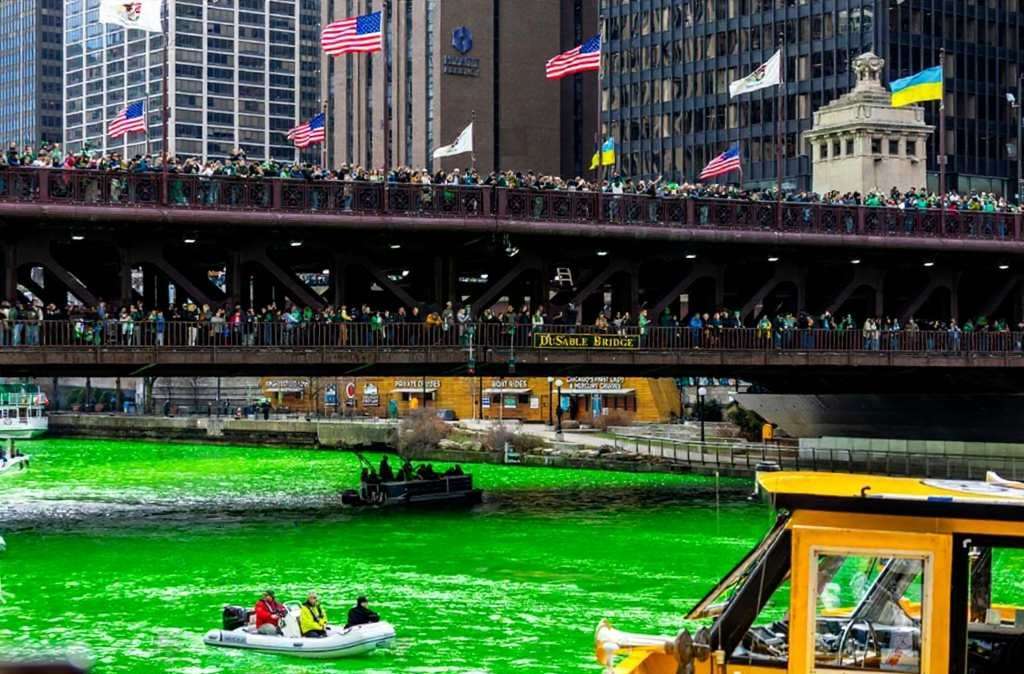
The magic happens the moment the powder hits the water. Through an immediate chemical reaction, the orange powder blossoms into a brilliant emerald green. The process is a well-oiled machine. Two to three motorboats from the Plumbers Union perform the honors. One larger boat dumps between 40 and 60 pounds of the powder into the river just east of the DuSable Bridge (Michigan Avenue), creating a thick, concentrated streak of color. Smaller boats then zip back and forth through the dyed water, acting like giant egg beaters to churn the color and ensure it spreads evenly from bank to bank.
The initial streak of green is intense and almost fluorescent before it mellows into a rich, opaque emerald. The vibrant color holds for about five to six hours, allowing plenty of time for photos and for parade-goers to marvel at the sight before it naturally dissipates into Lake Michigan.
Pro-Tip: Many first-time visitors worry about the environmental impact. Rest assured, the original oil-based fluorescein dye was replaced with the current eco-friendly, vegetable-based powder decades ago. The Plumbers Union takes immense pride in the tradition being a safe spectacle that harms no wildlife.

Your Ultimate Viewing Guide for the St. Patrick's Day Chicago River Dyeing
Securing a good spot to watch the river dyeing is the single most important part of your plan. The event officially begins at 10:00 AM, but the crowds start forming hours earlier. Here are the best places to stake your claim, broken down by experience.
For the Iconic Postcard Shot: The Bridges
The East Side of the DuSable Bridge (Michigan Avenue): This is ground zero, the quintessential, postcard-perfect view. You get the iconic architecture, the Wrigley Building, the river, and the boats all in one frame. However, it is the most crowded spot on the planet for that hour. You must arrive by 7:00 AM, at the latest, to get a front-row spot against the railing.
The West Side of the Columbus Drive Bridge: Offering another fantastic, elevated vantage point, this bridge is slightly less famous than Michigan Avenue, so it can be marginally less packed. It’s also very close to the parade’s starting point, making for an easy transition.
For an Immersive, Water-Level View: The Riverwalk
The Chicago Riverwalk (Upper and Lower Levels): The stretch of the Riverwalk between Michigan Avenue and Columbus Drive puts you right at water level. It offers a unique and dramatic perspective as the green tide flows past. It’s fantastic for close-up photography and feeling completely immersed in the action. The lower level fills up extremely fast, and police will restrict access once it hits capacity, so get there early and be prepared to stay put.
For a More Relaxed, Crowd-Averse Experience
West of Michigan Avenue (Wabash, State, or Dearborn Street Bridges): The further west you go from the main dyeing area, the thinner the crowds become. You can still see the beautifully green river from these bridges without the intense crush of people. This is an excellent option for families with small children or anyone who prefers a bit more breathing room. You won't see the boats actively dumping the dye, but you'll see the stunning final product.
The St. Patrick's Day Chicago Game Plan: A Minute-by-Minute Timeline
To truly master the day, you need a strategy. Here is a timeline for Saturday, the Saturday before St. Patrick's Day, to ensure you see everything without the stress.
It’s a crucial distinction for planning: St. Patrick’s Day itself falls on Monday, March 17, 2026, but the city holds its main celebrations—the dyeing and the parade—on the preceding Saturday, March 15th. This allows for the largest possible turnout and a full day of festivities.
7:00 AM - 7:30 AM: The Early Bird Gets the View This is not an exaggeration. If you want a prime spot on the Michigan or Columbus bridges, you need to be there now. Grab a coffee and a pastry, dress in more warm layers than you think you need (the wind off the river is biting), and claim your territory. The city is still quiet, and the energy is just starting to build.
8:00 AM - 9:30 AM: The Green Tide Rises The crowds will begin to pour in. The bridges and the Riverwalk will fill up rapidly. This is the time to hold your ground and soak in the atmosphere. It’s a fantastic people-watching opportunity as the city transforms into a sea of green attire, from shamrock glasses to full-blown leprechaun suits.
10:00 AM: The Magic Moment The Plumbers Union boats will make their appearance. Watch as the crew begins dispersing the secret orange powder. You’ll see the first vibrant streaks of green appear in the boat’s wake, quickly spreading across the river’s surface as the crowd erupts in a collective cheer. This is the moment you came for.
10:30 AM - 11:30 AM: Soak It In and Reposition The river is now a stunning sheet of emerald. Take your photos and enjoy the incredible sight. Once the dyeing is complete, the crowds will begin to shift as people start moving toward the parade route. This is your window to either grab a quick bite or start making your way south to Columbus Drive.
Feeling inspired to document this incredible day? Capture every vibrant moment with our free The Travel Creator's Toolkit, packed with guides for stunning photography and videography to make your memories last a lifetime.
Navigating the Parade: From Columbus Drive to Victory
With the river successfully turned green, the city’s attention shifts to the grand St. Patrick's Day Parade. This is a massive celebration of Irish heritage featuring hundreds of groups, including traditional bagpipers, Irish dancers, elaborate floats, and local dignitaries.
Parade Start Time: 12:15 PM
Parade Route: The parade proceeds north along Columbus Drive, starting at Balbo Drive and ending at Monroe Drive. The main viewing stand is located in front of Buckingham Fountain.

Tips for a Great Parade Experience:
Best Viewing Spot: The area around Buckingham Fountain is the heart of the action, but it’s also the most crowded. For a more relaxed experience, find a spot further north along Columbus Drive toward Monroe.
Arrive with a Plan: The parade route is long. Pick a spot and stick to it. Trying to move through the dense crowds once the parade starts is nearly impossible.
Facilities: Portable restrooms are available along the route, but expect long lines. Plan accordingly. Food and drink vendors are also present, but it’s wise to bring your own water and snacks to avoid the high prices.
Pro-Tip: Public transportation is your best friend. The CTA 'L' trains will be packed, but they are far more efficient than trying to drive and park anywhere near Grant Park. Street closures are extensive. Exit at a stop in the Loop and walk the final few blocks to the river or parade route.
Beyond the River: Celebrating Like a Chicagoan
The river dyeing and parade are the main events, but the celebration extends throughout the city. To truly experience the day like a local, consider adding one of these activities to your itinerary.
Visit an Authentic Irish Pub: Chicago has a rich Irish heritage and the pubs to prove it. Head to neighborhoods like River North or Lincoln Park to find establishments like The Kerryman or Fado Irish Pub for a pint of Guinness, some traditional corned beef and cabbage, and live music.
Explore the Irish American Heritage Center: Located on the city's northwest side, this center often hosts a full-day festival with music, dance, food, and cultural exhibitions, offering a deeper connection to the holiday’s roots away from the downtown crowds.
Enjoy a Themed Cruise: Several boat tour companies offer special St. Patrick's Day cruises on the green river. This is a fantastic way to get an unparalleled view away from the crowded bridges, though tickets are pricey and must be booked months in advance.
Planning a bigger trip around this event? Our comprehensive Travel Guide has everything you need to explore Chicago's neighborhoods, find the best eats, and build the perfect itinerary for a multi-day adventure in the Windy City.

Your Mission, Should You Choose to Accept It
You are now armed with the secrets of the green river, a strategic timeline, and insider tips to navigate the festivities. You have the knowledge to bypass the chaos and witness one of the world's most unique and joyful celebrations like a seasoned pro. The magic of St Patrick's day Chicago is not just in the spectacle itself, but in the shared energy of a city coming together to create something beautiful and fleeting. So, dress in your finest green, brave the March chill, and go make memories that will last far longer than the color in the river.
Travel News


Comments 0
No comments yet
Be the first to share your experience!
You May Also Like

Southwest Airlines Pulls Out of Chicago O'Hare and Washington Dulles


San Francisco Cherry Blossoms: A Local's Guide to the Blooms

Halloween SF: Haunts Without Horrors

SF Festivals: 7 Must-See Lineups

Christmas SF: Lights & Wharf Wonders

SF Pride: 6 Route & Party Hacks
TrekGuider @trekguider
7-Day Solo Travel Itinerary: A Perfect First-Trip Template

You're ready for an adventure that's entirely your own. No more compromising on destinations, no more syncing schedules. Just you, the open road, and the profound freedom of solo travel.
But a blank page can be intimidating. The excitement of the idea is quickly replaced by the paralysis of planning. Where do I start? How do I build a solo travel itinerary that's exciting but not overwhelming? How do I stay safe?
The good news is that you don't need to reinvent the wheel. You need a proven framework, a reliable playbook to guide you. This article provides the ultimate solution: a flexible 7-day solo travel itinerary that acts as the perfect template for your first independent adventure. It’s designed to eliminate guesswork, build confidence, and ensure an unforgettable experience.
While planning a trip for one has a very different set of challenges than coordinating group travel, as detailed in our guide to Family Travel Ideas: The 2026 Guide to Unforgettable Trips, the need for a solid plan remains universal. This guide is your key to unlocking that journey, transforming apprehension into pure excitement.
Your Pre-Flight Checklist: Engineering a Stress-Free Start
A smooth trip begins long before you pack your bags. Solid preparation is the antidote to travel anxiety, transforming "what ifs" into "I've got this."

1. Choose a Beginner-Friendly Destination
For your first solo trip, set yourself up for success by picking a location known for its strong tourist infrastructure and safety. You're looking for a "soft landing."
Top Contenders: Think cities like Lisbon (Portugal Travel Guide), Dublin, Kyoto (Japan Travel Guide), or Vancouver. These spots are celebrated for being affordable, walkable, friendly, and supremely safe.
The Litmus Test: Can you get around easily on public transport? Is it known for being safe, particularly for solo travelers? Is Wi-Fi widely available?
2. Select Your Home Base Wisely
Recommended: Stress-Free Flying with Kids: Airport, TSA, and In-Flight Guide
Recommended: Travel Guide: Trip Planning, Flights, and Avoiding Tourist Traps
Your accommodation is more than a place to sleep; it's your sanctuary and command center.
Boutique Hostels (with Private Rooms): The gold standard for many first-timers. You get the social energy of a common room and organized tours, plus the quiet retreat of your own space. It's the perfect balance of community and privacy.
Boutique Hotels or Guesthouses: A step up in privacy and comfort. Small, locally-owned spots often provide a warmer, more personal touch than soulless chains, and the staff can be a goldmine of local tips.
Centrally Located Airbnbs: Ideal if you crave a "live like a local" vibe and a kitchen. Stick exclusively to hosts with a "Superhost" designation and dozens of positive reviews that specifically mention safety, cleanliness, and an excellent location.
3. A Quick Word on Budgeting for Your First Solo Trip
A clear budget isn't a restriction; it's freedom. It frees you from money-related stress on the road. For a 7-day city trip, a simple framework is:
Fixed Costs: Pre-booked flights and accommodation.
Daily Average: Set a realistic daily budget for food, activities, and transport. Research costs in your chosen city (e.g., a meal in Lisbon is far cheaper than in Zurich). A good starting point for many European or North American cities is $75-$125 per day.
Contingency Fund: Always have an extra 20% of your total budget tucked away in a separate account for unexpected opportunities or emergencies.
4. A Pro's Approach to Solo Safety
Your confidence is directly linked to how safe you feel. Build a fortress of preparation. For a deeper dive, especially for female travelers, our Solo Female Travel Safety Guide is an essential resource.
Digital Security: Download offline maps of your city on Google Maps. Use a VPN on public Wi-Fi. Scan your passport and important documents and save them to a secure cloud service like Dropbox.
Situational Awareness: The "Morning Photo" protocol is a great habit for solo travelers. Snap a quick selfie each morning. In an emergency, it provides an exact, current visual reference.
Contingency Plan: Before you leave, share your detailed itinerary with someone at home. Establish a simple check-in cadence (e.g., a quick "all good" text each night).
Financial Safety: Carry a "decoy" wallet with a small amount of cash and an expired credit card. Keep your primary cards and the bulk of your cash in a secure money belt or a hidden internal pocket. Never keep all your money in one place.
Pro-Tip: Download the Noonlight app. It's a discreet safety button on your phone. If you're feeling uneasy, you can hold your thumb on the button. Release it and don't enter your PIN, and it will automatically alert local authorities with your exact location.
Your Ultimate Pre-Trip Tool
Feeling organized is feeling confident. Before you book a single flight, download our free International Travel Checklist. It’s a comprehensive resource that covers everything from passports and visas to packing and travel insurance, ensuring you don't miss a single crucial step.
The Perfect 7-Day Solo Travel Itinerary Blueprint
This is your playbook. The specific sights will change, but the strategic rhythm of this week is designed to maximize discovery while preventing burnout.

Day 1: Land Softly, Start Slow
Your only goal on day one is to land softly. Forget the pressure to do anything "touristy." The mission is simple: arrive, check-in, and breathe.
Afternoon (Arrival & Settle): Navigate from the airport to your lodging using a pre-vetted option—an official taxi stand, Uber/Lyft, or the city's express train. Avoid unsolicited ride offers. Once you drop your bags, take 30 minutes to actually unpack. This small act of nesting transforms a sterile room into your personal space.
Late Afternoon (The Reconnaissance Walk): Take a short, aimless walk with a purpose: to locate your vitals. Find the nearest ATM, pharmacy, small grocery store, and metro/bus stop. This simple recon mission builds a mental map and makes you feel instantly more capable.
Evening (The Easiest Dinner Ever): Your first meal should be low-stress. Find a casual, well-lit café or bistro within a few blocks of your accommodation. Ask for a table with a view of the street. This isn't just dinner; it's your first immersion.
Day 2: Find Your Anchor, Catch the Vibe
Today is about orientation. You'll anchor yourself with a major landmark and then plug into the city's authentic energy.
Morning (The Iconic Anchor): Head to the city's most famous landmark—the one on all the postcards. Book your ticket online, weeks in advance, to bypass the soul-crushing queues. Seeing this "anchor point" early gives your mental map a center of gravity.
Lunch (A Feast for the Senses): Skip the tourist-trap restaurants and head for a bustling local food market. It's a vibrant, low-pressure way to sample authentic cuisine. Graze from different stalls, trying whatever looks and smells incredible.
Afternoon (The Ultimate Solo Travel Hack): Join a "free" walking tour (they run on tips, so bring cash). A passionate local guide will give you a brilliant crash course in the city's history, secrets, and layout. It's also an effortless way to be around fellow travelers.
Evening (Culture or Comfort): If you're energized, catch a local performance—traditional music, a play, anything that gives you a taste of the culture. If you're tired, there is zero shame in a simple dinner and an early night. Listen to your body.
Day 3: Pursue Your Passion
This is your trip. Today is dedicated entirely to whatever makes you tick.

Morning (The Deep Dive):
Art Lover? Lose yourself in a world-class museum or hunt for street art in a bohemian neighborhood.
History Buff? Explore that niche museum or archaeological site that fascinates you.
Foodie? Take a local cooking class. It's one of the best ways to meet people, learn a skill, and eat an amazing meal.
Nature Enthusiast? Escape to the city's largest park or botanical garden for a few hours of green therapy.
Afternoon (The Art of Getting Lost): Pick a neighborhood that intrigued you and put your phone on airplane mode. Allow yourself to wander without a destination. Follow a charming alleyway, pop into a random shop, sit on a bench. This is where the magic happens.
Evening (A Table for One, with a View): Treat yourself. Find a restaurant or rooftop bar with a spectacular view. Order a great meal, and toast to your adventure. Worried about dining alone? Bring a journal and write about your day—it makes you look like a mysterious travel writer, not a lonely tourist.
Day 4: Gain Perspective with a Day Trip
Escaping the city for a day provides a vital change of scenery and proves your growing travel competence.
Full Day: Choose a destination one or two hours away by train or bus. Think a coastal village, a historic castle, or a national park. The journey itself is part of the adventure.
The Mission: This trip breaks the routine and shows you a completely different facet of the country. It also flexes your navigation skills and builds immense confidence. Successfully planning and executing a day trip on your own is a huge milestone.
Logistics: Research train/bus schedules the night before. Pack a small daypack with a water bottle, snacks, a portable charger, and a light jacket.
Day 5: Live Like You Belong Here
Today, your goal is to blend in. Shed the tourist skin and adopt the rhythms of a local.

Morning (The Café Ritual): Find a small, neighborhood café far from the tourist trail. Order a coffee, grab a pastry, and settle in with a book or journal for an hour. Watch the morning commute, listen to the chatter—just be.
Mid-Day (A Mundane Mission): Do a normal-person errand. Browse a local bookstore, buy fruit at a grocer, or find a post office to mail cards home. These simple tasks ground you in the reality of the place.
Afternoon (Scheduled Downtime): Hit the pause button. You are not a travel machine. Go back to your room for a nap. Read a book on a park bench. Do absolutely nothing. This is a vital part of sustainable travel.
Evening (The Local's Recommendation): Ask a local you've had a pleasant interaction with—your barista, a friendly shopkeeper—"Where's your favorite place to eat around here?" Their recommendation will almost always be more authentic and delicious than anything on a top-ten list.
Day 6: The Open Road and a Fond Farewell
Leave this day largely unplanned. It's a blank page for you to fill with whatever your heart desires.
Morning (Encore or Exploration): Is there a neighborhood you fell in love with? Go back. Did a fellow traveler tell you about a hidden gem you can't stop thinking about? Go find it. This is your flex day to chase your curiosity.
Afternoon (Meaningful Mementos): If you're buying souvenirs, seek out items that tell a story. Skip the generic trinkets and look for local crafts, specialty foods, a vintage poster, or a book from a local author.
Evening (The Last Supper): Make your final dinner a celebration of your journey. Return to a favorite spot or try that one special place you've been saving. As you eat, reflect on the week. Think about what you've learned, the challenges you've overcome, and the person you've become.
Day 7: Depart with Your Head Held High
The last day is for a smooth, grateful exit. No frantic rushing.
Morning: Enjoy one last coffee and pastry at your favorite café. Take a final, mindful walk down a beloved street, soaking in the sights and sounds.
Pack & Go: Head back to your room for a final pack-up. Leave ample time for your journey to the airport. Strolling calmly to your gate is a far better feeling than sprinting.
At the Airport: Once you're through security, pause. Take a deep breath. You did it. You took the dream of solo travel and forged it into reality. Acknowledge the magnitude of that achievement.
Frequently Asked Questions
What is the best way to handle feeling lonely on a solo trip?
It's completely normal to feel a pang of loneliness. The best strategy is to be proactive. Stay in social accommodations like a boutique hostel, join a walking tour or a cooking class on days you crave interaction, and find a cozy café to simply be around the comforting buzz of other people.
Is it awkward to eat at restaurants alone?
Not at all! It's a skill that gets easier with practice. Start with casual cafes, bring a book or journal to feel more comfortable, and try sitting at the bar where you can often chat with the bartender. Soon you'll find it's a peaceful and empowering experience.
How can I stay safe when going out at night by myself?
A: Prioritize well-lit, busy areas and research neighborhoods beforehand. Tell someone where you're going, use ride-sharing apps like Uber instead of walking in unfamiliar areas late at night, and always be mindful of your drink. Trust your intuition—if a place feels off, leave immediately.
What's the most common mistake first-time solo travelers make?
The most common mistake is over-scheduling. New solo travelers often try to fill every single minute to avoid being alone with their thoughts. The real magic happens in the unplanned moments, so be sure to build plenty of downtime and flexibility into your itinerary.
Welcome Home, Traveler: This Is Just the Beginning
Walk through that arrival gate on your way home, and you won't be the same person who left. A solo trip is a declaration—proof that you are more capable, resilient, and fiercely independent than you might have ever allowed yourself to believe.

This solo travel itinerary was never just about seeing a new place; it was about discovering a new version of yourself. Use this template, adapt it, and carry the confidence you've earned into planning your next adventure. When you're ready to go from template to a fully-realized plan, our comprehensive Travel Guide is the perfect next step to turning your dream trip into a reality. Because this isn't the end of one journey; it's the beginning of a lifetime of them.
Read the full guide: Family Travel Ideas: The 2026 Guide to Unforgettable Trips
Travel News
Comments 0
No comments yet
Be the first to share your experience!
You May Also Like

Ultimate USA Holidays Guide: Top Picks

FTC Affiliate Disclosure: Stay Compliant as a Travel Creator

Essential Affiliate Tools: From Tracking to Full Optimization

Booking.com Affiliate Review: Pros, Cons & Earnings

Decoding Affiliate Commission Rates: Benchmarks for Travel Creators

Amazon Associates for Travel: Strategies to Maximize Commissions
TrekGuider @trekguider
75+ Travel Blog Post Ideas to Beat Writer's Block

Let's be honest: the blinking cursor is the most intimidating opponent a travel creator can face. You're sitting on a goldmine of experiences from your latest trip, camera roll overflowing, yet the well of inspiration has run dry. You know you need to publish to keep your momentum, but you’re stuck. You see the creators featured in our definitive guide to The Best Travel Blogs to Follow in 2026 publishing incredible content, and the pressure to keep up feels immense.
This isn't just a fleeting moment of frustration; it's a critical business bottleneck. In the competitive world of travel media, an inconsistent publishing schedule kills momentum, damages your search engine authority, and puts a hard ceiling on your income. Every day you spend wondering what to blog about travel is a day you're not growing your audience or your business.
This article is your way out. Think of this as your permanent, strategic cure for writer's block. Below, you won't just find a list of 75+ prompts. You'll get a battle-tested resource bank organized by the single most important concept in content creation: user intent. This is the framework you need to build a content calendar that consistently attracts new readers, fosters a loyal community, and systematically drives revenue for your brand.
Understanding Intent: The Key to Knowing What to Blog About Travel
Before we get to the ideas, we need to talk strategy. Every single time a person uses a search engine, they have a goal. They're not just typing words; they're asking a question, looking for a story, or preparing to make a purchase. A professional content strategy doesn't just guess at topics; it systematically targets these different user intents.
The Professional's Cure: From Ideas to Strategy
The difference between an amateur blog and a professional media brand isn't the quantity of ideas, but the strategy behind them. The permanent cure for writer's block isn't just a list of topics; it's a framework for thinking about how each piece of content serves your audience and your business. This is how you build a content funnel:
Informational (Top of Funnel): The user has a practical question (e.g., "Do I need a visa for Thailand?"). Your job is to provide the most comprehensive, authoritative answer on the internet, introducing them to your brand as a trusted resource.
Inspirational (Middle of Funnel): The user is in the dreaming phase. They want personal stories, evocative photo essays, and relatable mishaps. Here, your goal is to forge a genuine connection and build the trust that turns a first-time visitor into a loyal follower.
Transactional (Bottom of Funnel): The user is ready to act. They're comparing products, looking for reviews, and about to spend money (e.g., "Sony a7CR review for travel"). Your goal is to provide expert recommendations that help them make a confident decision, generating affiliate income or direct product sales for you.
A successful blog is a masterfully balanced ecosystem of all three content types. It's how you create a sustainable business that serves people at every single stage of their travel journey.

Informational Guides (Top of Funnel): Become the Go-To Resource
These articles are the foundation of your search traffic. They answer the core questions your audience has and are your primary tool for building topical authority with search engines. Be relentlessly helpful.
The Ultimate Guide to [Destination]
How to Get from [Airport] to City Center
When is the Best Time to Visit Country?
Do I Need a Visa for Country?
A Complete Guide to Public Transportation in [City]
Is [City] Safe for Solo Female Travelers?
Understanding Currency and Tipping in Country
What to Pack for a Trip to [Destination]
The Best Neighborhoods to Stay in [City]
How to Plan a Number-Day Itinerary for [Destination]
A Local's Guide to the Best Hidden Gems in [City]
The Complete Language and Culture Guide for Country
Navigating Holiday/Festival in [City]
How Much Does a Trip to Country Really Cost? A Detailed Budget Breakdown
Is Travel Insurance for Country Worth It? A 2026 Analysis
Inspirational Stories (Middle of Funnel): Building Your Loyal Community
Facts inform, but stories connect. This is your chance to share your unique voice, perspective, and personality. In an increasingly automated world, our market research confirms that authenticity is your single greatest asset. This is where you build your true tribe.
How Traveling to Country Changed My Perspective on Life
Our Biggest Travel Mishap and What We Learned From It
Why I Quit My Job to Travel the World (And What I'd Do Differently)
A Day in the Life of a Digital Nomad in [City]
The Most Humbling Experience I Had in Country
Meeting Locals: The Unforgettable Story of Person's Name
Overcoming My Fear of Activity in Place
Finding Love on the Road: Our Story
A Letter to My Younger Self Before My First Solo Trip
The Kindness of Strangers: A Story from Country
Why We Choose to Travel with Our Kids, Even When It's Hard
The Most Beautiful Place I’ve Ever Seen
My Favorite Travel Memory of All Time
What I Wish I Knew Before Backpacking Through Region
A Photo Essay: The Faces of Country
Pro-Tip: True authenticity includes the struggles. Don't be afraid to write about the delayed flights, the questionable street food, or the moments of loneliness. These are the stories that make you human and build unshakable trust with your audience.

Transactional Reviews (Bottom of Funnel): Driving Your Revenue
This content targets readers with high purchase intent. They are actively seeking expert guidance before they spend their money. Your honest, detailed, and experience-backed reviews provide immense value to them and are a primary driver of revenue for your business.
Airline Business Class Review: Is It Worth the Upgrade?
An Honest Review of the Hotel Name in [City]
Is the City Name Pass a Good Value? A Full Breakdown
The 5 Best Travel Backpacks for 2026: An In-Depth Test
Comparing Tour Company A vs. Tour Company B for Activity
A Review of Travel Product: The Good, The Bad, and The Ugly
The Best Travel Credit Cards for Earning Points This Year
My Experience Renting a Car in Country with Rental Company
Camera Model Review: Is This the Ultimate Travel Photography Camera?
The Only Packing Cubes You'll Ever Need: A Head-to-Head Comparison
Review: Travel Insurance Provider
The Best Travel Shoes for Walking All Day (After 500 Miles of Testing)
A Guide to the Best Group Tours for Solo Travelers
Which E-SIM is Best for International Travel?
Portable Charger Brand Review: Will It Keep You Powered Up?
How-To Tutorials (Practical Value): Proving Your Deep Expertise
Tutorials are powerhouse content. They solve a very specific problem, demonstrating your expertise in a tangible way. A great "how-to" post can become a key element piece of content that drives traffic, email sign-ups, and product sales for years.
How to Pack for a Two-Week Trip in Only a Carry-On
How to Plan a Trip Using Google Maps and Google My Maps
How to Find the Cheapest Flights to Anywhere (My Step-by-Step Method)
How to Overcome Jet Lag: A Science-Backed Guide
How to Use a Travel Rewards Credit Card to Book a Free Flight
A Beginner's Guide to Taking Better Travel Photos with Your Phone
How to Stay Fit and Healthy While Traveling Long-Term
How to Create a Realistic Travel Budget (and Actually Stick to It)
How to Learn Basic Phrases in a New Language Quickly
How to Navigate a Foreign Supermarket Like a Local
How to Do Your Laundry While Traveling
How to Stay Safe as a Solo Traveler: 10 Essential Tips
A Step-by-Step Guide to Getting Your First Passport
How to Set Up a Travel Blog (The 2026 Tech Guide)
How to Edit Your Travel Photos to Look Professional

Ready to Monetize Your Expertise?
Creating world-class "how-to" content is the first step. The next is to package that knowledge into a premium product you can sell. The most profitable travel creators are building businesses around their own digital products—from itineraries to e-books to workshops.
Our free Digital Product Ideas Guide is your official playbook for this transition. Download it to get a curated list of product ideas you can create and start selling today.
Listicles (Highly Shareable): Maximizing Your Traffic and Reach
Listicles are popular for a reason: they are incredibly effective. They're scannable, digestible, and highly shareable on visual platforms like Pinterest, making them a fantastic tool for driving top-of-funnel traffic and getting your brand in front of new audiences.
15 Must-See Places in Country That Aren't in the Guidebooks
10 Foods You Absolutely Have to Try in [City]
The 7 Best Day Trips from [City]
21 Things to Know Before You Visit Country
The Top 10 Most Beautiful Beaches in Region
5 Common Travel Scams in [City] and How to Avoid Them
12 Unique and Authentic Souvenirs to Buy in Country
The 8 Best Hostels in [City] for Solo Travelers
10 Instagrammable Spots in [City] (and How to Get the Shot)
7 Mistakes to Avoid When Visiting Tourist Attraction
25 Famous Movie Locations You Can Actually Visit
The 10 Best Cities in the World for Foodies
8 Apps Every Traveler Should Have on Their Phone
The Top 5 National Parks for Family Adventures
11 Insanely Beautiful Castles You Can Stay In
9 Reasons Why You Should Travel Solo at Least Once
The 12 Best Travel Books to Inspire Your Next Adventure
Pro-Tip: The secret to a successful listicle is a sharp, unique angle. Don't just write "Things to Do in Rome." Instead, write "10 Things to Do in Rome to Escape the Crowds." Specificity is what makes you stand out from the generic content and attract a dedicated reader.
Your Next Steps: A Creator's FAQ
How many blog posts should I have before I launch?
Our research on successful blog launches points to a magic number: between 10 and 20 foundational articles. This gives visitors enough content to explore and signals to Google that you're a serious resource. Aim for a mix of the content types above.
How do I make time to create all this content?
Focus on batching your work. Dedicate one day to outlining several posts, another to writing, and another to creating graphics and social media assets. A strategic workflow is more important than raw hours.
How do I turn this content into a real business?
The path is to transition from content creator to media entrepreneur. Use your informational and inspirational posts to build an audience, then create your own digital products—like detailed itineraries, e-books, or Lightroom presets—that solve your audience's biggest problems. This is why platforms like the TrekGuider Platform (Seller Signup) are so valuable; they handle the complex technical side of sales, letting you focus on creating.

From Inspired Creator to Thriving Entrepreneur
The blinking cursor has lost its power. You now have a practical plan and a treasure trove of ideas to build a content calendar that serves your audience and grows your business. You have the tools to know exactly what to blog about travel at any given moment. By intentionally blending these different types of content, you’re no longer just publishing posts—you're building a powerful, predictable, and profitable travel media brand.
The final step is to use the trust and authority you've built. The most successful creators in 2026 are not relying on ad revenue; they are building their own economies by selling their expertise directly to their audience. You have the knowledge. You have the stories. It's time to turn them into your own line of digital products.
The TrekGuider Platform was built specifically for this purpose. It is the simplest, most powerful way to upload, market, and sell your digital travel guides, itineraries, and courses to a passionate global audience. Stop being just a blogger. Start building your empire.
Meta Data Suggestions:
SEO Meta Title: 75+ Travel Blog Post Ideas to Beat Writer's Block
URL Slug: travel-blog-post-ideas
SEO Meta Description: Never wonder what to blog about travel again. Get 75+ strategic post ideas to beat writer's block, attract readers, and build a profitable travel blog.
Travel News
Comments 0
No comments yet
Be the first to share your experience!
You May Also Like
Ultimate USA Holidays Guide: Top Picks
FTC Affiliate Disclosure: Stay Compliant as a Travel Creator
Essential Affiliate Tools: From Tracking to Full Optimization

Avoid These 5 Affiliate Landing Page Mistakes for Better Conversions

Affiliate Keyword Research Mastery for Travel Blogs
Booking.com Affiliate Review: Pros, Cons & Earnings
TrekGuider @trekguider
Europe's New ETIAS Entry System Launches Late 2026: Here's What Americans Must Know

After years of delays, the European Union's ETIAS travel authorization system is finally set to launch in late 2026 — and it will affect every American visiting the Schengen Zone.
ETIAS (European Travel Information and Authorisation System) is not a visa. It's an electronic pre-screening requirement similar to the U.S. ESTA program for visitors from visa-waiver countries. American travelers will need to apply online and receive approval before boarding a flight to any of the 30 Schengen member states.
The application process is straightforward: fill out a form with personal details, passport information, and basic security questions. The fee is €7 (approximately $8) for travelers aged 18–70. Those under 18 or over 70 are exempt.
Most applications should receive approval within minutes, though some may take up to 72 hours if flagged for additional review. An approved ETIAS authorization remains valid for three years or until the linked passport expires, whichever comes first.
The system covers all 27 EU Schengen members plus Iceland, Liechtenstein, Norway, and Switzerland. It does not apply to non-Schengen EU countries like Ireland.
Travelers with European trips booked for late 2026 or beyond should factor ETIAS into their pre-departure checklist. While the rollout date hasn't been pinned to a specific month, the EU has committed to going live before year's end.
For those already holding valid Schengen visas, ETIAS will not be required during the visa's validity period.
Travel News
Comments 0
No comments yet
Be the first to share your experience!
You May Also Like

This Colorado Resort Delivers a European Alps Experience Without the Transatlantic Flight

How to Travel Europe Alone: A 2026 First-Timer's Guide

How to Solo Travel Europe: A Step-by-Step First-Timer's Plan
Solo Travel Europe Without Going Broke: A Realist's Guide

Top 7 Family Vacation Destinations in Europe (For All Ages)
