
Essential Affiliate Tools: From Tracking to Full Optimization

TrekGuider @trekguider
You’re a creator, not an administrator. Yet, you find yourself drowning in a sea of administrative tasks. You’re manually copying and pasting ugly, mile-long affiliate links, toggling between a dozen different program dashboards to check your stats, and spending more time wrestling with spreadsheets than you do creating the travel content you love. Your affiliate "business" feels less like a streamlined operation and more like a chaotic, time-sucking hobby that isn't paying the bills.
This inefficiency is more than just frustrating—it's a silent killer of your income. Every hour you spend on manual, repetitive tasks is an hour you’re not creating the next piece of content that could generate revenue for years to come. You're flying blind, guessing which strategies are working, unable to see which links are converting, and which pages are actually profitable. The reported average income of $13,847 a month for travel affiliates feels like a distant fantasy when you’re stuck in this administrative quicksand.

This guide is your way out. It is your curated, creator-friendly tech stack—a definitive list of the essential affiliate marketing tools that will automate the tedious, provide crystal-clear data, and free you up to focus on growth. We’ll cover the entire workflow, from foundational link management and tracking to the advanced tools needed for full-scale optimization. This is how you transform your passion project into a professional, efficient, and profitable business. For a complete command of the entire affiliate landscape, our definitive pillar page, Travel Affiliate Programs: The 2026 Ultimate Guide, is your essential command center for mastering the entire ecosystem.
The Foundational Layer: Your Operational Command Center
Before you can optimize, you must organize. This first set of tools forms the non-negotiable foundation of any serious affiliate marketing business. They are your central nervous system for managing links, ensuring compliance, and tracking performance from a single source of truth.
Link Management Plugins (The Digital Quartermaster)
If you run your travel blog on WordPress, a link management plugin is the single most important tool you will install. These plugins take the long, ugly, and intimidating affiliate links provided by programs and "cloak" them into short, clean, branded URLs that are far more trustworthy to your audience.
Think of it as your command center. Instead of embarking on a digital scavenger hunt through year-old posts to update a single expired link, you change it once in a central dashboard, and the plugin deploys that change site-wide instantly. This functionality alone will save you hundreds of hours over the life of your business. Furthermore, a link like yourblog.com/recommends/osprey-backpack is infinitely more professional and trustworthy to a reader than a long URL filled with random tracking parameters, directly impacting your click-through rates.

Top Tools in This Category:
ThirstyAffiliates: A powerhouse plugin built specifically for affiliate marketers. It offers advanced features like autolinking (automatically turning specific keywords into affiliate links), proactive link checking to find broken links, and detailed click analytics.
Pretty Links: A slightly simpler but highly effective alternative. It excels at link cloaking, redirection, and providing basic click-tracking reports right from your WordPress dashboard.
Pro-Tip: The best link management plugins, like ThirstyAffiliates, can automatically add the required rel="sponsored" tag to all of your affiliate links. This is a critical feature that ensures you stay compliant with Google's guidelines for paid links, protecting your site from potential SEO penalties without you having to think about it.
Affiliate Tracking Tools (Your Source of Truth)
"What gets measured gets managed." To grow your affiliate income, you need a crystal-clear understanding of what’s working. While many creators start by manually checking each affiliate network’s dashboard, a dedicated approach to tracking provides a more holistic, actionable view.
For most creators, your affiliate tracking tools will be a combination of your link management plugin’s analytics and the dashboards provided by your affiliate networks (like CJ Affiliate or Travelpayouts). These platforms show you crucial metrics like clicks, conversions, and commission earnings.
However, as your business matures, you'll want to track performance across different income models. For example, the TrekGuider Seller Platform includes a dedicated referral dashboard. This is a specialized tracking tool that shows you not just one-time sales, but the ongoing, passive income you’re earning from the new sellers you’ve brought to the platform. It’s a perfect example of how a modern platform provides the built-in affiliate tracking tools you need to monitor more sophisticated, high-margin income streams like revenue sharing.
The Growth Engine: Traffic & SEO Tools
With your operational house in order, the focus must pivot from organization to acquisition. A perfectly managed link is useless without a steady stream of the right people clicking on it. This is where your growth engine comes in—the tools designed to attract your ideal audience with precision.
SEO & Keyword Research Platforms
The most profitable affiliate content is created with intention. It targets keywords that signal a user is actively researching a purchase (e.g., "best carry-on luggage review"). SEO platforms are your treasure map for finding these "money" keywords and building a content strategy that attracts buyers, not just browsers.

These platforms are indispensable for:
Finding Profitable Keywords: Uncover what your audience is searching for, how many people are searching for it, and how difficult it will be to rank on Google.
Analyze the Competition: See exactly which keywords your competitors are ranking for and which pages are bringing them the most traffic.
Track Your Performance: Monitor your rankings for your target keywords over time to see what’s working and where you need to improve.
Top Tools in This Category:
Ahrefs: A comprehensive, professional-grade SEO toolkit. Its "Keywords Explorer" is second to none for finding high-value commercial investigation keywords, and its "Site Explorer" provides deep insights into any competitor's strategy.
SEMrush: Another all-in-one industry leader that offers a powerful suite of tools for keyword research, rank tracking, and competitive analysis.
Pro-Tip: Don't confine your keyword strategy to your blog. With video projected to account for a staggering 55% of all affiliate traffic by 2026, the same commercial-intent keywords you find for your articles are the exact titles you should be using for your YouTube videos and TikToks.
Analytics Platforms
While SEO tools help you get traffic, a web analytics platform tells you what that traffic does once it arrives. It’s essential for understanding your audience, diagnosing problems, and optimizing their journey from reader to buyer.
The Must-Have Tool:
Google Analytics: The free, industry-standard tool for website analytics. It's an incredibly powerful platform that provides all the data you need to understand user behavior, track conversions, and identify your top traffic sources, allowing you to double down on what works.
The Conversion Toolkit: Optimization & Social Media Tools
Attracting traffic is only half the battle. The final, crucial step is converting that traffic into clicks and commissions. This set of tools is designed to streamline your workflow and optimize your content for maximum impact.
"Link in Bio" Tools (For Social Dominance)
Platforms like Instagram and TikTok are powerful for audience building, but they famously limit your ability to use clickable links. A "link in bio" tool solves this by creating a simple, mobile-friendly landing page that can house all of your most important affiliate links, blog posts, and offers.

Top Tools in This Category:
Linktree: The most well-known tool in this space, offering a simple and effective way to create a micro-landing page for your social media bio.
Later: While primarily a social media scheduling tool, Later’s "Link in Bio" feature is excellent, allowing you to create a clickable grid of your Instagram posts, driving traffic directly to relevant blog posts and affiliate offers.
The Amazon Workflow Accelerator
For nearly every travel creator, Amazon Associates is a core part of their affiliate strategy. However, creating links for individual products can be a slow, manual process.
The Must-Have Tool:
Amazon SiteStripe: This is a free, official toolbar from Amazon that appears at the top of your browser whenever you’re on Amazon.com. It allows you to generate a custom affiliate link (text, image, or both) for any product page with a single click, dramatically speeding up your content creation workflow.
Your Strategy Blueprint: The Travel Creator's Toolkit
Feeling overwhelmed by the options? A powerful tech stack is only as good as the strategy behind it. To help you organize your entire affiliate marketing plan—from keyword research to content creation and promotion—we've created the ultimate resource bundle. It’s packed with the checklists, templates, and guides you need to build a professional and profitable system.
Download Your Free Bundle: The Travel Creator's Toolkit Today!
Frequently Asked Questions (FAQ)
1. Do I really need all these tools when I'm just starting out? When you're starting, focus on the foundation. A WordPress site with a link management plugin (like Pretty Links) and Google Analytics is your essential starting stack. This is a low-cost setup that allows you to organize your links and track your traffic from day one. You can invest in a premium SEO tool like Ahrefs once your site is generating enough revenue to justify the cost.
2. Are there any good free affiliate marketing tools? Absolutely. Google Analytics is free and non-negotiable. Amazon SiteStripe is also free. For keyword research, you can start with free tools like Google Keyword Planner or the free versions of various SEO tools, though they are more limited. The free versions of "link in bio" tools like Linktree are also perfectly sufficient for most creators.
3. How do these tools help with tracking beyond just clicks? Advanced tracking involves connecting data points. For instance, by using UTM parameters (which you can add manually or with some plugins), you can see in Google Analytics not just that someone came from your blog, but that they came from the specific button in your review of the Osprey backpack. This level of detail is what allows you to A/B test different calls-to-action and truly optimize your pages for conversion.
Conclusion: From Hobbyist to CEO
The difference between a creator earning a few dollars a month and one earning a full-time income often comes down to their systems. Top earners don't waste time on manual, low-value tasks. They leverage technology to work smarter, not harder. They treat their content not as a hobby, but as a business.

You now have a curated list of the best affiliate marketing tools to build your own professional tech stack. Start with the foundation: a link management plugin to organize and track your links. Then, layer in SEO and analytics tools to build a predictable stream of traffic. Finally, use optimization and workflow tools to convert that traffic with maximum efficiency.
These affiliate tracking tools and optimization platforms are not an expense; they are an investment in your own efficiency, professionalism, and profitability. By implementing this toolkit, you take a definitive step away from being a hobbyist and become the CEO of your own thriving travel content business.
Meta Data Suggestions:
SEO Meta Title (58 characters): 9 Essential Affiliate Marketing Tools for Travel Creators
URL Slug: essential-affiliate-marketing-tools
SEO Meta Description (154 characters): Discover the top affiliate marketing tools for travel creators. From link tracking to SEO, this guide covers the essential tech stack to automate and grow your income.
Read the full guide: The Travel Blogger's Playbook to Affiliate Marketing Mastery
Don't Miss Out! Subscribe for Exclusive Content
Subscribe



Comments 0
No comments yet
Be the first to share your experience!
Dont Miss Out! Subscribe for Exclusive Content

Ultimate USA Holidays Guide: Top Picks


FTC Affiliate Disclosure Essentials: Stay Compliant as a Travel Creator

Avoid These 5 Affiliate Landing Page Mistakes for Better Conversions

Affiliate Keyword Research Mastery for Travel Blogs

Booking.com Affiliate Program Review: Pros, Cons, and Earnings Potential

Decoding Affiliate Commission Rates: Benchmarks for Travel Creators
6 Proven Models to Make Money Online Blogging
TrekGuider @trekguider
You’ve launched your travel blog, a digital space filled with your passion, expertise, and stunning photography. The problem? It feels more like an expensive hobby than a business. You're caught in a strategic fog, constantly hearing about different ways to monetize but paralyzed by the sheer number of options. Should you chase ad revenue, dive into affiliate marketing, or invest months creating a digital product?
This confusion is more than just frustrating; it's a barrier to growth. Every month spent hesitating is a month of lost income and mounting burnout. You see other creators achieving financial freedom and can't help but wonder what strategic blueprint they're following. You're putting in the work, but without a clear understanding of the fundamental business models, your efforts feel scattered and ineffective, keeping your dream of a profitable blog just out of reach.

It's time to trade that confusion for clarity. This article is your high-level strategy session. We will demystify the process by providing a strategic analysis of the six proven models to make money online blogging. We’ll move beyond tactics ("how") and focus on strategy ("what" and "why"), comparing the pros, cons, and profit potential of each approach. This is the essential framework you need to choose the right path for your blog and your goals. Think of this as your strategic map—for the full, step-by-step expedition, be sure to read our ultimate guide on How to Make Money Online: A Creator's Guide for 2026.
Model 1: Display Advertising (The Traffic Monetizer)
Display advertising is often the first monetization model bloggers think of. It involves placing ads on your website, typically managed through an ad network, and earning revenue based on the number of people who see or click on them. It’s a passive model that directly translates website traffic into income.
Pros:
Truly Passive Income: Once set up, ad networks automatically fill your ad spaces, generating revenue from your existing traffic without requiring any additional action per visitor.
Low Barrier to Entry (Theoretically): While premium networks have high traffic thresholds, the basic concept of placing ads is straightforward and doesn't require direct selling.
Cons:
Requires Massive Traffic: Meaningful revenue is almost entirely dependent on having a large and consistent stream of visitors. For context, our research shows only 4% of global creators earn over $100,000 per year, and those with high ad revenue are traffic powerhouses.
Can Degrade User Experience: Ads can be intrusive, slow down your website's loading speed, and detract from the professional aesthetic you’ve worked hard to create.
Who It's Best For: Established bloggers with high, consistent search engine traffic. This is typically not a lucrative model for beginners, but it becomes a reliable income floor for blogs with over 50,000 monthly sessions.
Pro-Tip: Aspiring bloggers should skip low-paying beginner networks like Google AdSense. Instead, focus 100% of your energy on growing traffic to meet the minimum requirements for premium ad networks like Mediavine (50,000 monthly sessions) or Raptive. The revenue difference is dramatic and can single-handedly take a blog's income past the $1,000/month mark.

Model 2: Affiliate Marketing (The Trusted Recommender)
Affiliate marketing is a performance-based model where you earn a commission for promoting another company’s products or services. You place a unique, trackable link in your content, and when a reader makes a purchase through that link, you receive a percentage of the sale. It allows you to monetize your genuine recommendations.
Pros:
Low Cost of Entry: You don't need to create a product, handle inventory, or manage customer service. You simply recommend products you already use and trust.
Scalable and Passive: A single, high-performing blog post with affiliate links can rank on Google for years, generating commissions long after you’ve hit publish.
Cons:
Dependency on Partners: You are reliant on the affiliate partner's terms. Commission rates can be changed or eliminated with little notice, as seen when Amazon dramatically cut its rates for many categories.
Reputational Risk: Your credibility is on the line. If you recommend a poor-quality product, you risk eroding the trust you've built with your audience, which is your most valuable asset.
Who It's Best For: Bloggers in any niche who have built a foundation of trust with their audience. It's an ideal "next step" after you've started generating traffic, as it allows you to monetize your expertise without the heavy lift of product creation.
Model 3: Digital Products (The Scalable Asset)
This is where you ascend the monetization ladder, transforming your expertise into scalable assets you own completely. This model involves creating and selling your own intangible products that can be distributed repeatedly online. For travel bloggers, this includes eBooks, online courses, itinerary templates, and Lightroom presets.
Pros:
Exceptionally High Profit Margins: With no inventory or shipping costs, digital products offer unparalleled profitability. The "create once, sell forever" model means nearly every sale after you recoup your time investment is pure profit.
Full Ownership and Control: You control the product, the pricing, the marketing, and the customer relationship. This insulates your business from the volatility of ad networks and affiliate partners.
Positions You as an Expert: Selling a high-quality product like a comprehensive Travel Guide solidifies your authority in your niche like nothing else. Once created, a platform like the TrekGuider marketplace gives you an immediate, professional storefront to connect with travelers actively seeking that expertise.
Cons:
Significant Upfront Investment: Creating a high-quality product requires a substantial investment of time, research, and effort before you ever make a dollar.
Requires Marketing and Sales Skills: You are responsible for everything, from building a high-converting sales page to handling customer service inquiries.
Who It's Best For: Established bloggers with a proven, engaged audience that has a specific problem you can solve. With the e-learning market alone projected to reach an incredible $848 billion by 2030, this model has the highest long-term ceiling for growth.
This is the model with the highest ceiling, but it requires the right tools to get started. That's why we built a launchpad for creators ready to build their own assets.

Your Creator Business Launchpad
Feeling inspired to build your own assets but not sure where to begin? The first step is to master the tools of the trade. Our The Travel Creator's Toolkit is a free collection of resources designed to help you streamline your workflow, create stunning content, and build a business that lasts. It includes templates, checklists, and guides to accelerate your journey from blogger to entrepreneur.
Download Your Free Travel Creator's Toolkit Now
Model 4: Services (The Cashflow Generator)
This is the most direct way to make money online blogging: selling your time, skills, or expertise. For a travel creator, this could mean freelance writing for tourism boards, offering social media management for hotels, providing one-on-one trip planning consultation, or offering photography services.
Pros:
Fastest Path to Significant Income: Services are often the quickest way to generate substantial revenue, especially for new creators who have a marketable skill but not yet a large audience.
Premium Pricing Potential: You can charge high rates based on your expertise and the value you deliver to a client.
Cons:
Not Scalable (Active Income): This model involves a direct trade of time for money. There is a hard ceiling on your potential earnings because there are only so many hours in a day. If you stop working, the income stops.
Can Lead to Burnout: Juggling client work with building your own blog can be demanding and can distract from creating the long-term assets that lead to passive income.
Who It's Best For: New bloggers with a professional skill (writing, photography, marketing) who need to generate income quickly. It's also great for experts in a specific field who want to validate their knowledge before packaging it into a more scalable digital product.
Pro-Tip: Frame your services as a strategic launchpad, not a permanent business model. Use the active income from freelance work to pay your bills and fund the time you need to invest in building scalable, passive income streams like affiliate content and digital products.
Model 5: Sponsored Content, the Right Way to Make Money Online Blogging with Brands
Also known as brand partnerships, this model involves collaborating with companies to create content that promotes their products or services in exchange for a fee. This can range from a single sponsored blog post to a long-term brand ambassadorship.
Pros:
Can Be Extremely Lucrative: Sponsored content can be a massive source of revenue. In fact, our 2026 Creator Monetization Report found that 69% of creators cite brand partnerships as their most profitable income stream.
Enhances Credibility: Partnering with respected brands that align with your values can enhance your own credibility and authority in your niche.
Cons:
Requires an Established, Engaged Audience: Brands want to see a strong track record and a clear return on their investment, which typically means you need a substantial and highly engaged following to attract premium partnerships.
Risk of Losing Audience Trust: Income can be inconsistent and dependent on securing new deals. More importantly, if a sponsorship feels inauthentic or is not disclosed transparently, it can permanently damage your relationship with your audience.
Who It's Best For: Influential bloggers with a highly engaged, niche audience. This model works best when you have a strong brand identity that is attractive to companies targeting your specific demographic.

Model 6: Subscriptions & Memberships (The Community Builder)
This model generates predictable, recurring revenue by charging a regular fee (monthly or annually) for access to exclusive content, a private community, or premium features. This could be a paid newsletter, a private Slack or Discord group, or a membership site with exclusive articles and videos.
Pros:
Predictable, Recurring Revenue: Subscriptions provide a stable and forecastable income stream, which is a huge advantage over the fluctuating nature of ad revenue or one-off product sales.
Fosters a Loyal Community: This model is designed to serve your most dedicated fans, creating a loyal and highly engaged community around your brand.
Cons:
Requires Constant Value Delivery: To prevent churn (cancellations), you must consistently deliver high-value, exclusive content. The pressure to "feed the beast" can be intense.
Subscriber Fatigue is Real: In a world saturated with subscriptions, convincing new members to sign up can be challenging.
Who It's Best For: Creators with a highly dedicated and engaged audience who are looking for a deeper connection. It's an advanced model that works best when you've already established significant authority and trust.
Frequently Asked Questions About Monetization Models
1. What's the best model for a brand new blogger?
For immediate income, Services are unmatched if you have a marketable skill like writing or design. However, for long-term, scalable growth, your initial focus should be on creating high-quality content that will eventually support Affiliate Marketing and Display Advertising once your traffic grows.
2. Is it better to focus on one model or do everything at once?
Focus on one, then stack. The most common mistake is trying to do everything and mastering nothing. Follow the "Monetization Ladder" concept. For example, master creating content that drives affiliate revenue. Once that system is working, use your authority to build and sell a Digital Product. Trying to launch a course, a membership, and a freelance business all at once is a recipe for burnout.
3. How much traffic do I really need for display ads to be worthwhile?
Don't even consider it until you can qualify for a premium ad network. The industry standard benchmarks are 50,000 monthly sessions for Mediavine or 100,000 monthly pageviews for Raptive. Anything less than that, and your time is far better spent on content creation and affiliate strategy.
Choosing Your Path

There is no single "best" way to make money online blogging. The most successful creators understand that these models are not mutually exclusive; they are rungs on a "Monetization Ladder." A new blogger might start by offering services to generate immediate cash flow. As their traffic grows, they add display advertising and affiliate marketing. Finally, with an established and trusting audience, they ascend to the highest rung by launching their own digital products and membership communities.
You now have the practical plan to analyze these models and choose the right one for your current stage. Don't fall into the trap of trying to do everything at once. Pick a path, master it, and then climb to the next rung. This is how you build a diversified, resilient, and highly profitable blogging business.
Read the full guide: The Travel Blog Business Plan: How to Make Real Money in 2026
Don't Miss Out! Subscribe for Exclusive Content
SubscribeComments 0
No comments yet
Be the first to share your experience!
Dont Miss Out! Subscribe for Exclusive Content
FTC Affiliate Disclosure Essentials: Stay Compliant as a Travel Creator

Essential Affiliate Tools: From Tracking to Full Optimization
Avoid These 5 Affiliate Landing Page Mistakes for Better Conversions
Affiliate Keyword Research Mastery for Travel Blogs
Booking.com Affiliate Program Review: Pros, Cons, and Earnings Potential
Decoding Affiliate Commission Rates: Benchmarks for Travel Creators
The Travel Blogger's Playbook to Affiliate Marketing Mastery
TrekGuider @trekguider
Most articles about affiliate marketing for bloggers give you a list. This is not one of those articles. A list won't teach you that the difference between earning $50 a month and $5,000 a month isn't the number of programs you join—it's the business strategy you deploy. The top 1% of travel bloggers don't just 'add links'; they build sophisticated affiliate marketing engines that run on audience trust, strategic content, and diversified revenue streams. This guide is the blueprint to that engine. We'll cover the programs, yes, but more importantly, we'll give you the complete practical plan to turn your passion into a predictable, profitable business.

At its core, affiliate marketing is beautifully simple: you earn a commission for recommending products and services you already use, love, and trust. When a reader clicks your unique referral link and makes a purchase, the brand pays you a percentage as a thank you. It's the most organic and authentic way for travel content creators to monetize their work, weaving recommendations seamlessly into the stories and advice they’re already sharing. This isn't about plastering your site with blinking, irrelevant banner ads; it's about monetizing the trust you’ve worked so hard to build.
The Foundation: Why Most Bloggers Fail at Affiliate Marketing (And How You'll Succeed)
Before we even mention a single program, let's address the hard truth: most bloggers who try affiliate marketing fail to earn anything meaningful. They treat it like a lottery, scattering links across their site and hoping for a lucky sale. This tactical, hope-based approach is doomed to fail.
Sustainable success in this field isn't about tactics; it's about strategy. It's about building a business system where affiliate income is the natural, inevitable byproduct of the immense value you provide. By understanding the common pitfalls from the outset, you can sidestep the mistakes 99% of bloggers make and architect a monetization engine built for long-term, predictable success.
It's a Business, Not a Tactic

Let’s start with the single most important mental shift you need to make: you are not just a blogger. You are the founder of a media company. Your blog is its flagship publication, and affiliate marketing for bloggers is your first—and most important—revenue division.
A tactical blogger asks, "Where can I put this link?" A strategic business owner asks, "What problem does my audience have, and which product is the absolute best solution I can recommend to solve it?" This subtle reframing changes everything. It shifts your focus from selling to serving. Your content transforms from a sales pitch into an indispensable resource, and your affiliate links become helpful signposts on your reader's journey, not distracting billboards. Master this mindset, and you've already won half the battle.
The Triangle of Trust: Niche, Audience, Authenticity
High affiliate conversion rates are a direct result of one thing: audience trust. You can have the most beautiful website and the cleverest link placements, but if your readers don't truly trust your recommendations, you will not make a single sale. In our experience, unshakable trust is built on three inseparable pillars:

A Well-Defined Niche: You cannot be everything to everyone. A laser-focused niche (e.g., "solo female travel in Southeast Asia," "luxury family travel in Europe," "budget backpacking in South America") allows you to become a true expert. This perceived expertise is the bedrock of authority and trust. If you're just getting started, our guide on is a crucial first step.
Deep Audience Understanding: Once you have your niche, you must become obsessed with understanding the people within it. What are their biggest fears about booking a trip? What are their most pressing, unanswered questions? What specific problems can you solve for them? When you understand your audience on this level, you can create content that speaks directly to their needs, making your affiliate recommendations feel less like an advertisement and more like a personal, can't-miss suggestion from a trusted friend.
Unshakeable Authenticity: This is the glue that holds it all together. Only recommend hotels, tours, gear, and services that you have used yourself and genuinely believe in. Your audience is savvy; they can spot a phony, profit-driven recommendation from a mile away. Had a bad experience with a popular tour? Say so. Found a hotel to be overrated? Share that, too. This radical honesty—even when it means forgoing a commission—builds immense long-term credibility that will pay dividends for years to come.
Why a Small, Engaged Audience is More Valuable Than a Large, Passive One
One of the most pervasive and damaging myths in the blogging world is that you need hundreds of thousands of page views to earn significant affiliate income. This is demonstrably false. While traffic is a component of the equation, it is far from the most important one. Engagement and intent matter infinitely more.
Consider two of our creators:
Blogger A has 100,000 monthly visitors to a generic "cheap travel deals" blog. Their audience is broad, unengaged, and looking for quick transactions. Their affiliate conversion rate is a dismal 0.1%.
Blogger B has just 5,000 monthly visitors to their niche blog about "scuba diving for beginners." Their audience is highly targeted, deeply engaged, and actively seeking expert advice. Their conversion rate on dive gear and course recommendations is a healthy 3%.
Despite having 20 times less traffic, Blogger B will earn significantly more affiliate income. Their audience isn't just passing by; they are leaning in, listening, and ready to act on trusted advice. The lesson is clear: do not wait for massive traffic to begin. Focus first on building a small, loyal, and highly engaged community. The income will follow.
Affiliate Networks vs. Direct Programs

Once you’ve built your foundation of trust, it’s time to understand the operational machinery of the affiliate world. There are two primary ways to partner with the brands you love: through large affiliate networks or by establishing direct, one-on-one partnerships. Making a deliberate choice here is a critical structural decision for your business, as we explore in our deep dive into .
What are Affiliate Networks? The Pros and Cons of Centralization
Affiliate networks like Travelpayouts, CJ Affiliate, or ShareASale act as massive marketplaces. They are the intermediaries connecting thousands of bloggers (publishers) with thousands of companies (brands). You join the network, and from one central dashboard, you can apply to the individual programs of countless brands, from hotel chains to tour operators.
The Pros of Affiliate Networks:
Radical Efficiency: This is the headline benefit. You get one login, one dashboard to track all your performance metrics, and one consolidated monthly payment. This dramatically simplifies the administrative side of your business.
A World of Variety: Networks give you instant access to a huge catalog of potential partners, making it easy to find and test programs that perfectly fit your niche.
Effortless Discovery: They are an excellent tool for discovering new and relevant brands you might not have found otherwise.
The Cons of Affiliate Networks:
Program Volatility: This is the biggest risk. A brand can leave a network at any time. If a major hotel chain you promote heavily switches networks, you could face the monumental task of finding and updating hundreds of links across your site.
A Middleman's Margin: Networks need to get paid, too. That often means the commission rate you see on a network is slightly lower than what you could get by negotiating a direct deal, as the network skims a percentage off the top for their services.
Impersonal Relationships: Communication is often filtered through the network, making it harder to build a strong, personal relationship with a brand's affiliate manager that could lead to special opportunities.
The Pros and Cons of Individual Partnerships
The alternative is to bypass the networks and apply directly to a brand's in-house affiliate program. Many of the world's top travel companies, from airlines to gear manufacturers, run their own programs for this very reason.
The Pros of Going Direct:
Higher Earning Potential: By cutting out the middleman, you can often secure higher commission rates. Over time, that extra 1-2% on your top partners adds up to significant income.
Powerful Relationships: A direct partnership allows you to build a real relationship with the affiliate manager. This can lead to exclusive coupon codes for your audience, co-branded marketing campaigns, and world-class support.
Fortress-Like Stability: Your partnership is not subject to the whims of a network. As long as the brand runs its program, your links are secure.
The Cons of Going Direct:
Administrative Overload: This is the trade-off. Every direct partnership means a separate login, a different dashboard, a unique payment threshold, and another platform to manage. Five direct partners are manageable; fifty is a nightmare.
Higher Barriers to Entry: It can be more difficult for new bloggers with low traffic to get approved for prestigious direct programs.
Time-Consuming Discovery: You have to actively hunt down these programs, which can be a significant time investment.
Our Verdict: A Hybrid Strategy for Maximum Earnings
For 99% of travel bloggers, the optimal approach is a hybrid strategy. It provides the perfect balance of efficiency and earning potential, giving you the best of both worlds.
Here’s the playbook: Start by joining one or two core affiliate networks (like Travelpayouts) to gain access to a broad range of programs. Use this to efficiently test what resonates with your audience. As you analyze your data, you will inevitably identify a small handful of "powerhouse" affiliates—the two or three brands that generate 80% of your income. For these mission-critical partners, it is absolutely worth the extra administrative effort to leave the network and establish a direct relationship. This hybrid model gives you operational simplicity for the masses and maximum profitability for your champions.
A Deep Dive into the Top 3 Travel Affiliate Networks
Choosing the right network is a foundational decision that will shape your workflow. While dozens of options exist, three platforms consistently rise to the top for travel bloggers due to their brand inventory, powerful features, and strategic focus.
Travelpayouts: The All-in-One Travel Specialist
Travelpayouts has masterfully positioned itself as the premier affiliate network built by travel experts, for travel experts. It consolidates over 100 of the world's leading travel brands into a single, intuitive platform, making it an incredibly powerful and efficient hub for your business.
The genius of Travelpayouts is its singular focus. You won't waste time sifting through irrelevant retail or finance offers. Every single brand, from giants like Booking.com (we have a dedicated if you want to dive deep) and Viator to niche local tour operators, is directly relevant to your content. Their standout feature is the "LinkSwitcher" tool—a brilliant script that automatically converts direct brand links on your site into your unique affiliate links. This alone can save you dozens of hours and is a game-changer for monetizing old content. For bloggers who want to cover every facet of travel without juggling ten different platforms, Travelpayouts is the undisputed champion.
Stay22: The Tech-Forward Accommodation Innovator

Stay22 is a more specialized but incredibly powerful player, particularly for bloggers whose content is heavily focused on accommodations. While they partner with all the major booking sites like Expedia and Hotels.com, their true advantage lies in their innovative, AI-powered technology.
Their flagship "Let Me Allez" script automatically scans your site for mentions of locations and hotels and converts them into monetized affiliate links—a massive time-saver. Even better, Stay22 enables you to create beautiful, interactive maps that display real-time accommodation options in a specific area. You can embed these maps directly into posts like "Where to Stay in Rome," providing immense visual value to your readers while seamlessly monetizing their journey. For creators who want to leverage cutting-edge tech to enhance user experience and maximize accommodation revenue, Stay22 is an essential tool.
CJ Affiliate (Commission Junction): The Legacy Giant with Global Reach
CJ Affiliate is one of the oldest and largest affiliate networks on the planet. While it isn't travel-specific, its sheer scale means it is home to some of the biggest names in the industry, including major airlines, hotel groups like IHG, and iconic tour companies like G Adventures.
The primary advantage of CJ is its vast scope. If your blog has a "lifestyle" component that extends beyond pure travel—perhaps into photography gear, outdoor clothing, or online courses—you can manage all those affiliate partnerships within the same CJ dashboard. This is a significant benefit for established, multi-niche bloggers aiming for diversification. While its interface can feel a bit more corporate than its travel-focused peers, its reliability, best-in-class tracking, and portfolio of top-tier brands make it a key element platform for any serious affiliate marketer.
Building Your Ultimate Affiliate Portfolio: Top Programs by Category
While networks provide the operational backbone, the heart of your strategy lies in the individual programs you champion. A well-curated portfolio is like a diversified investment portfolio; it maximizes returns by aligning with your audience's needs at every stage of their journey. We've handpicked some of the in the most critical categories, complete with the data you need to make smart, strategic decisions.

Accommodations: Booking.com, Agoda, Hostelworld
This is often the most lucrative category. You are helping your readers make one of the most important—and expensive—decisions of their trip.
Booking.com: The undisputed king. Its massive inventory, trusted brand name, and sky-high conversion rates make it a non-negotiable for nearly every travel blogger.
Commission Rate: ~4% of the booking value (varies)
Cookie Duration: Session-based. Strategic Implication: This means you need to capture high-intent readers who are ready to book now. Your content should be action-oriented.
Agoda: A powerhouse in the Asian travel market. If your blog focuses on Asia, featuring Agoda is a must to cater to regional preferences and pricing.
Commission Rate: Up to 7%
Cookie Duration: 30 days
Hostelworld: The go-to platform for budget and solo travelers. If your niche is backpacking or your audience skews younger, this program is essential.
Commission Rate: 20-40% of the deposit paid
Cookie Duration: 30 days
Tours & Activities: Viator & GetYourGuide
Tours and activities are a fantastic way to earn commission while genuinely enhancing your readers' trips. This is where you help them create memories.
Viator: Owned by TripAdvisor, Viator boasts an unparalleled inventory of tours worldwide. Its brand recognition and easy-to-use interface drive solid conversions.
Commission Rate: 8%
Cookie Duration: 30 days
GetYourGuide: A major competitor with a slightly more modern, curated feel. It's smart to join both, as some of the best tours are exclusive to one platform. This allows you to always recommend the absolute best option.
Commission Rate: 8-10%
Cookie Duration: 30 days
Flights & Transport: Skyscanner, Discover Cars
Flight commissions are notoriously low, but rental cars offer a significant earning opportunity.
Skyscanner: The most popular flight comparison tool. You won't get rich promoting it, but including Skyscanner links is a helpful service that builds reader trust.
Commission Rate: Varies (often a % of Skyscanner's revenue)
Cookie Duration: 30 days
Discover Cars: A leading car rental comparison site with stellar reviews. With rentals often costing hundreds of dollars, commissions can be substantial.
Commission Rate: Up to 70% of their profit
Cookie Duration: 365 days. Strategic Implication: A year-long cookie is a game-changer. A reader can click your link during initial research and book nine months later, and you still get paid.
Travel Insurance: SafetyWing & World Nomads
Promoting travel insurance is not just a smart business decision; it's an ethical obligation. It's a critical purchase, and the recurring commission models can build a foundation of predictable income.
SafetyWing: Hugely popular with digital nomads for its flexible monthly subscription model. This recurring commission is the holy grail for building a stable income base.
Commission Rate: 10% on all sales (including recurring subscriptions)
Cookie Duration: 365 days
World Nomads: An established and trusted name, particularly in the adventure travel community. Their brand authority helps convert readers who are on the fence.
Commission Rate: 10%
Cookie Duration: 60 days
Gear & Products: Amazon Associates, REI, Osprey

Recommending the gear you personally use is one of the most powerful forms of affiliate marketing. These recommendations are rooted in your authentic experience.
Amazon Associates: The world's largest affiliate program. While commissions can be low, its massive product selection and high likelihood of a user buying multiple items make it a necessary part of any gear strategy. For a deep dive, check out our guide on .
Commission Rate: 1-4% (varies by category)
Cookie Duration: 24 hours
REI: The gold standard for outdoor and adventure gear in the U.S. Their trusted brand and high-quality products make it a great alternative to Amazon for a specialized audience.
Commission Rate: 5%
Cookie Duration: 15 days
Osprey: Many top gear brands, like the beloved backpack manufacturer Osprey, run their own direct affiliate programs. If you're a passionate advocate for a specific brand, always check for a direct program—the commissions are often higher.
Commission Rate: 8%
Cookie Duration: 30 days
While linking to individual items is effective, many readers seek a curated, all-in-one solution. This is a perfect opportunity to link to your own helpful resource, like our free PDF on . It provides value far beyond a simple product link and opens an entirely new revenue stream when you create your own products.
How to Add Links That Actually Convert
Knowing which programs to join is science. Knowing how to integrate your links is art. The goal is for every link to feel like a natural, helpful extension of your content, not a jarring interruption. This requires a thoughtful approach to placement, context, and language.
The Golden Rule: Recommend, Don't Sell

Your role is that of a trusted advisor, not a used car salesman. Your content should be 95% pure, unadulterated value and 5% thoughtful recommendation. When you do recommend a product, it should feel like the logical conclusion to the problem you've been helping the reader solve. For a masterclass on this, read our guide on .
Instead of: "You should buy this backpack. Here's the link."
Try: "After testing three different carry-on backpacks on my last trip to Europe, the Osprey Farpoint 40 was the clear winner. Its clamshell design made packing a breeze, and the suspension system was comfortable even after a full day of navigating Prague's cobblestone streets. If you're looking for a versatile one-bag travel solution, this is the one I wholeheartedly recommend."
The second example works because it's rooted in experience, provides specific reasons, and is framed as a helpful solution.
Practical Placement: In-text Links, Comparison Tables, and Resource Pages
Forget flashy banner ads. They have abysmal click-through rates and cheapen your brand. The highest-converting links are almost always the ones most seamlessly integrated into your content. Mastering this requires a deeper understanding of search intent and SEO for.
In-Text Contextual Links: This is your bread and butter. A simple text link embedded naturally within a sentence—like one on the words "my favorite travel insurance"—is the most powerful and authentic way to make a recommendation.
Comparison Tables: When a reader is in the final decision-making phase, a simple, clear comparison table is an incredibly valuable tool. Creating a table comparing the features of 3-4 different travel insurance plans, complete with your affiliate links, can be a conversion powerhouse.
Resource Pages: Every blog needs a dedicated "Resources" or "Travel Gear" page. This acts as a curated list of all the products and services you use and recommend. It's a high-value asset for your readers and a simple way to house your most important links. Better yet, your TrekGuider creator page functions as an automatic, centralized hub for your audience, showcasing your articles, digital products, and top recommendations all in one place.
To elevate your destination guide from helpful to indispensable, embed a link to a product like the "Customizable Google Maps Itinerary for Rome" from the TrekGuider marketplace. This creates a powerful monetization stack: you earn affiliate commission from the hotel booking link within the guide and direct revenue from your high-value digital map, effectively doubling your earnings from a single reader.
A Simple Guide to Affiliate Disclosure
This is non-negotiable. For legal reasons (the FTC requires it) and for the even more important reason of maintaining audience trust, you must clearly and conspicuously disclose that you use affiliate links. The nuances are important, which is why we've created a dedicated guide on .
This is simple. A straightforward statement at the very top of your blog posts, before any affiliate links appear, is all you need. For example:
"A quick heads-up: This post contains affiliate links. If you make a purchase through one of them, I may earn a small commission at no extra cost to you. I only recommend products and services I personally use and love. Thanks for your support!"
Place a similar disclosure in your site's footer. Transparency isn't just a legal requirement; it's the currency of trust.
Using Affiliates to Validate Your Own Digital Products

This is the strategy that separates the top 1% of earners from everyone else. Affiliate marketing is not just a revenue stream; it is the ultimate market research tool. The data you collect should be the foundation for your next, more profitable venture: creating and selling your own digital products.
What Affiliate Data Tells You About Your Audience
Your affiliate dashboard is a goldmine. It's a direct, unfiltered look into the minds of your readers. Pay attention to the story it tells:
Which links get the most clicks? This reveals your audience's core interests. To get this data, you'll need the right tools, which we cover in our review of .
Which products actually sell? This tells you what they are willing to pay for.
What is the average purchase value? This helps you understand their budget.
If your article on "The Best Day Trips from Florence" consistently drives a high number of sales for a specific Vespa tour, that is a powerful signal. It tells you your audience is highly interested in Tuscan day trips and is willing to pay for a curated experience.
Creating Digital Products that Complement Your Affiliate Recommendations
Once you've identified these patterns, you can brainstorm digital products that offer a higher level of value than a simple affiliate link ever could. These products don't compete with your affiliate offers; they complement them. For inspiration, grab our free guide on .
This is precisely why we built TrekGuider. Instead of wrestling with e-commerce plugins, payment gateways, and file delivery systems, you can upload your guide to the TrekGuider marketplace in minutes. We handle the entire transaction, allowing you to focus on what you do best: creating invaluable resources for travelers.
Example: From Recommending a Viator Tour to Selling Your Custom Itinerary

Let's return to that Florence example. You see that the "Tuscany Vespa Tour" on Viator is a huge seller. Market validated. Now, you create your own premium digital product: "The Ultimate Self-Guided Vespa Itinerary for Tuscany." You could even bundle it with our comprehensive .
This downloadable PDF guide could include:
A detailed, day-by-day route optimized for jaw-dropping scenery.
A private Google Map with pinned locations for the best photo spots, local-approved lunch spots, and hidden gems.
A guide to renting a Vespa, including what to look for and what to avoid.
A checklist of what to pack for the perfect day.
You can sell this digital guide for $29, a price point that dwarfs the $5 commission you might earn from the tour booking. You've used affiliate data to validate an idea, created a more valuable solution, and built a revenue stream that you own 100%. This is the path from blogger to true business owner.
Frequently Asked Questions (FAQ Section)

How much can I realistically earn from affiliate marketing?
The range is massive. A new blogger should celebrate their first $100 month, which often takes 6-12 months of consistent work. An established blogger can earn $500 to $3,000 per month. A top-tier travel blog, run as a serious business, can generate well over $10,000 a month from affiliate revenue alone by focusing on . Your income will be a direct reflection of your audience's trust, the strategic quality of your content, and your commitment to this as a business.
How much traffic do I need to get started?
Forget the vanity metric of huge traffic numbers. Most affiliate programs have no minimum traffic requirements. You can be approved for Booking.com or Amazon Associates on day one. Your focus should be on creating high-quality, targeted content that answers a specific question for a small, engaged audience. One great article that ranks for a "buying intent" keyword—something you can master with —can earn more with 100 visitors than a generic post with 10,000.
Can I be an affiliate marketer without a blog?
Yes, you can. While a blog is the ideal asset because you own it, you can absolutely use affiliate links on other platforms. YouTube video descriptions, Instagram Stories (with a "link in bio" service), and even Pinterest are all viable channels. The core principles of trust, authenticity, and service remain exactly the same, regardless of the platform.
What's the difference between Pay-per-Sale and Pay-per-Lead?
These are the two main commission models:
Pay-per-Sale (PPS/CPA): This is the standard for travel. You earn a commission only when a reader clicks your link and completes a purchase.
Pay-per-Lead (PPL/CPL): Here, you earn a smaller, fixed fee when a reader simply signs up for something, like a newsletter, or a request for a quote. This is less common in travel but can be found with some travel agent services or cruise inquiries.
Your Action Plan: The First 30 Days to a Profitable Affiliate Strategy

Knowledge without action is just entertainment. Here is a simple, week-by-week checklist to take you from reading this guide to implementing a profitable affiliate marketing for bloggers engine. For even more actionable advice, check out our .
Week 1: The Foundation
[ ] Mindset Shift: Acknowledge you are building a business, not just a blog. Write down your income goal for the next 6 months.
[ ] Niche & Audience: Clearly define your niche and create a "reader persona"—a detailed description of your ideal audience member.
[ ] Trust Audit: Review your 10 most popular articles. Identify where you can add more value and authentic recommendations.
Week 2: The Ecosystem
[ ] Join a Network: Sign up for Travelpayouts. It's the most efficient starting point.
[ ] Apply to Core Programs: From within Travelpayouts, apply to Booking.com, Viator, and GetYourGuide.
[ ] Go Direct: Apply directly to the SafetyWing affiliate program and sign up for Amazon Associates.
Week 3: The Integration
[ ] Identify Opportunities: Go back to your top articles. Find 3-5 places in each where an affiliate link would be genuinely helpful.
[ ] Add Links & Disclosure: Generate your unique links and add them contextually. Add your affiliate disclosure to the top of each post.
[ ] Create Your Hubs: Build a "Resources" page on your blog and set up your free TrekGuider creator page to showcase your work.
Week 4: The Analysis & Next Steps
[ ] Learn Your Dashboard: Spend 30 minutes learning your affiliate dashboard. Pay attention to clicks to see what's resonating.
[ ] Plan New Content: Brainstorm 3 new "buying intent" articles (e.g., "The Best Travel Insurance for Europe," "A Review of the Osprey Fairview 40," "7 Unforgettable Day Trips from Rome").
[ ] Think Like an Owner: Start a list of potential digital product ideas based on your most popular content.
As you implement this plan and build your affiliate engine, remember that the ultimate goal is to own your revenue streams. To accelerate your transition from blogger to business owner, explore the "Travel Blogger's Business Toolkit" on the marketplace. It features professionally designed templates for media kits and brand proposals that will fast-track your growth.
Related Guides
- How to Start Affiliate Marketing as a Travel Creator
- Crafting Travel Product Reviews That Drive Affiliate Sales
- Social Media Affiliate Strategies Tailored for Travel Influencers
- 5 Critical Affiliate Marketing Mistakes to Dodge in 2026
- Amazon Associates for Travel: Strategies to Maximize Commissions
- High-Paying Affiliate Opportunities for Individual Travel Affiliates
- Referral Affiliate Programs in Travel: Boost Earnings Through Networks
- Top 11 High-Paying Affiliate Programs for Travel Bloggers
- 7 Proven Affiliate Marketing Tips to Skyrocket Travel Income
- Decoding Affiliate Commission Rates: Benchmarks for Travel Creators
- Booking.com Affiliate Program Review: Pros, Cons, and Earnings Potential
- Affiliate Keyword Research Mastery for Travel Blogs
- Avoid These 5 Affiliate Landing Page Mistakes for Better Conversions
- Essential Affiliate Tools: From Tracking to Full Optimization
- FTC Affiliate Disclosure Essentials: Stay Compliant as a Travel Creator
Don't Miss Out! Subscribe for Exclusive Content
SubscribeComments 0
No comments yet
Be the first to share your experience!
Dont Miss Out! Subscribe for Exclusive Content
FTC Affiliate Disclosure Essentials: Stay Compliant as a Travel Creator
Essential Affiliate Tools: From Tracking to Full Optimization
Avoid These 5 Affiliate Landing Page Mistakes for Better Conversions
Affiliate Keyword Research Mastery for Travel Blogs
Booking.com Affiliate Program Review: Pros, Cons, and Earnings Potential
Decoding Affiliate Commission Rates: Benchmarks for Travel Creators
St. Patrick's: River Dyeing Secrets
TrekGuider @trekguider
You’ve seen the photos, and they look impossible: a major American river, flowing through a canyon of skyscrapers, glowing with the emerald-green hue of a shamrock. It’s a spectacle so surreal it feels like a clever digital edit. But it’s real, and the biggest problem for any traveler is that witnessing this world-famous tradition feels like a logistical nightmare. Where are the best spots? What time do you really need to arrive to beat the hundreds of thousands of spectators? And how do they even accomplish this magical feat without creating an environmental disaster?
Without a rock-solid plan, you risk being swallowed by a sea of green, craning your neck for a sliver of water between a thousand heads, only to miss the fleeting moment of transformation. You could spend hours shivering in the Windy City's notorious March air and leave with nothing but a blurry photo and the bitter taste of disappointment. This iconic event is the dazzling centerpiece of the city's festive calendar, a unique urban ritual that we place in the broader context of the city's year-round celebrations in our complete guide to Chicago Holidays: Windy City Thrills. Don't let poor planning rob you of the magic.
This is your definitive insider’s guide. Forget the guesswork. We are pulling back the curtain on the river dyeing secrets, from the history and science behind the tradition to a minute-by-minute game plan for a perfect day. You will learn the absolute best viewing locations, the parade navigation hacks locals swear by, and how to transform a potentially chaotic day into an unforgettable urban adventure.

The Legend of the Green River: An Accidental Tradition
While Chicago’s St. Patrick's Day Parade is one of the nation's oldest, with roots stretching back to 1843, the tradition that truly puts it on the global map is much younger. The practice of dyeing the Chicago River green was born in 1962 from a moment of pure, serendipitous observation. Stephen Bailey, then the business manager of the Chicago Journeymen Plumbers Local Union, noticed that a dye plumbers used to detect leaks and pollution sources in the river had stained a worker's white overalls a perfect, brilliant shade of Irish green.
A lightbulb went off. If that small amount of dye could stain fabric so vividly, what could a larger quantity do to the entire Chicago River? The Plumbers Union, a key sponsor of the parade, decided to find out. For the inaugural dyeing, they released 100 pounds of the chemical into the river, which, to their astonishment, kept the waterway a radiant green for nearly a week. The spectacle was an instant sensation, captivating the city and cementing a new, indelible tradition. Over the decades, the process has been perfected and the formula made environmentally safe, but the magic—and the stewardship of the event—remains firmly in the hands of the Plumbers Union, proof of a quirky idea that became a beloved civic institution.
The Science of the Spectacle: How Orange Powder Turns a River Green
The most closely guarded secret in Chicago isn't a political backroom deal; it's the precise formula for the dye that transforms the river. What we do know is that it’s a vegetable-based powder, making it completely safe for the river's ecosystem. The real visual trickery, however, lies in its color. When you see the crew on the boats scooping the substance from its container, you’ll notice it’s a bright, fiery orange.
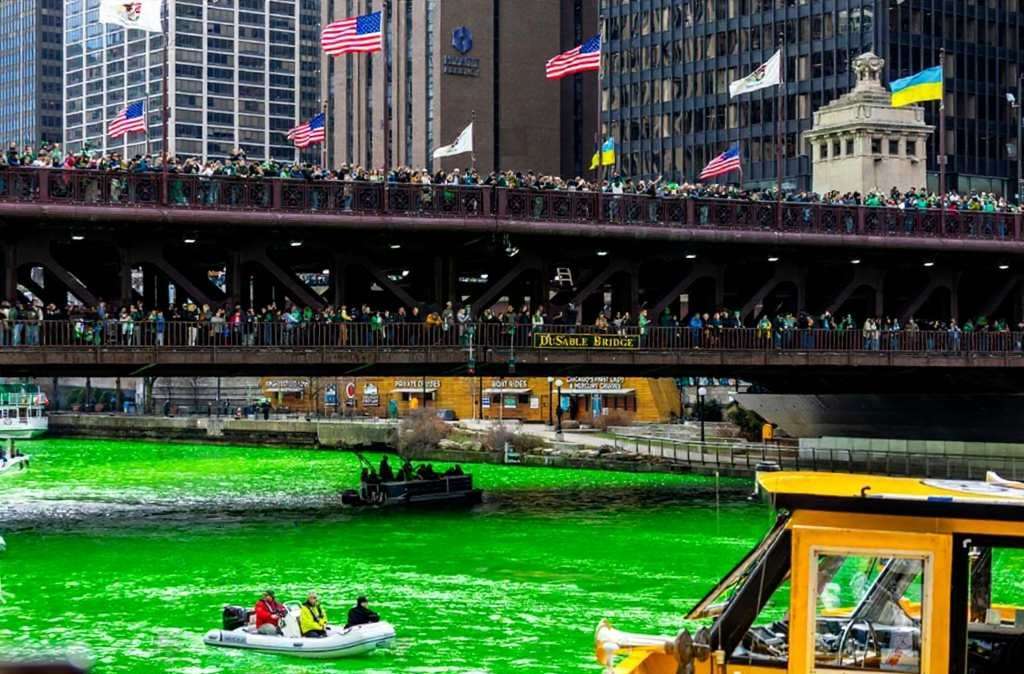
The magic happens the moment the powder hits the water. Through an immediate chemical reaction, the orange powder blossoms into a brilliant emerald green. The process is a well-oiled machine. Two to three motorboats from the Plumbers Union perform the honors. One larger boat dumps between 40 and 60 pounds of the powder into the river just east of the DuSable Bridge (Michigan Avenue), creating a thick, concentrated streak of color. Smaller boats then zip back and forth through the dyed water, acting like giant egg beaters to churn the color and ensure it spreads evenly from bank to bank.
The initial streak of green is intense and almost fluorescent before it mellows into a rich, opaque emerald. The vibrant color holds for about five to six hours, allowing plenty of time for photos and for parade-goers to marvel at the sight before it naturally dissipates into Lake Michigan.
Pro-Tip: Many first-time visitors worry about the environmental impact. Rest assured, the original oil-based fluorescein dye was replaced with the current eco-friendly, vegetable-based powder decades ago. The Plumbers Union takes immense pride in the tradition being a safe spectacle that harms no wildlife.

Your Ultimate Viewing Guide for the St. Patrick's Day Chicago River Dyeing
Securing a good spot to watch the river dyeing is the single most important part of your plan. The event officially begins at 10:00 AM, but the crowds start forming hours earlier. Here are the best places to stake your claim, broken down by experience.
For the Iconic Postcard Shot: The Bridges
The East Side of the DuSable Bridge (Michigan Avenue): This is ground zero, the quintessential, postcard-perfect view. You get the iconic architecture, the Wrigley Building, the river, and the boats all in one frame. However, it is the most crowded spot on the planet for that hour. You must arrive by 7:00 AM, at the latest, to get a front-row spot against the railing.
The West Side of the Columbus Drive Bridge: Offering another fantastic, elevated vantage point, this bridge is slightly less famous than Michigan Avenue, so it can be marginally less packed. It’s also very close to the parade’s starting point, making for an easy transition.
For an Immersive, Water-Level View: The Riverwalk
The Chicago Riverwalk (Upper and Lower Levels): The stretch of the Riverwalk between Michigan Avenue and Columbus Drive puts you right at water level. It offers a unique and dramatic perspective as the green tide flows past. It’s fantastic for close-up photography and feeling completely immersed in the action. The lower level fills up extremely fast, and police will restrict access once it hits capacity, so get there early and be prepared to stay put.
For a More Relaxed, Crowd-Averse Experience
West of Michigan Avenue (Wabash, State, or Dearborn Street Bridges): The further west you go from the main dyeing area, the thinner the crowds become. You can still see the beautifully green river from these bridges without the intense crush of people. This is an excellent option for families with small children or anyone who prefers a bit more breathing room. You won't see the boats actively dumping the dye, but you'll see the stunning final product.
The St. Patrick's Day Chicago Game Plan: A Minute-by-Minute Timeline
To truly master the day, you need a strategy. Here is a timeline for Saturday, the Saturday before St. Patrick's Day, to ensure you see everything without the stress.
It’s a crucial distinction for planning: St. Patrick’s Day itself falls on Monday, March 17, 2026, but the city holds its main celebrations—the dyeing and the parade—on the preceding Saturday, March 15th. This allows for the largest possible turnout and a full day of festivities.
7:00 AM - 7:30 AM: The Early Bird Gets the View This is not an exaggeration. If you want a prime spot on the Michigan or Columbus bridges, you need to be there now. Grab a coffee and a pastry, dress in more warm layers than you think you need (the wind off the river is biting), and claim your territory. The city is still quiet, and the energy is just starting to build.
8:00 AM - 9:30 AM: The Green Tide Rises The crowds will begin to pour in. The bridges and the Riverwalk will fill up rapidly. This is the time to hold your ground and soak in the atmosphere. It’s a fantastic people-watching opportunity as the city transforms into a sea of green attire, from shamrock glasses to full-blown leprechaun suits.
10:00 AM: The Magic Moment The Plumbers Union boats will make their appearance. Watch as the crew begins dispersing the secret orange powder. You’ll see the first vibrant streaks of green appear in the boat’s wake, quickly spreading across the river’s surface as the crowd erupts in a collective cheer. This is the moment you came for.
10:30 AM - 11:30 AM: Soak It In and Reposition The river is now a stunning sheet of emerald. Take your photos and enjoy the incredible sight. Once the dyeing is complete, the crowds will begin to shift as people start moving toward the parade route. This is your window to either grab a quick bite or start making your way south to Columbus Drive.
Feeling inspired to document this incredible day? Capture every vibrant moment with our free The Travel Creator's Toolkit, packed with guides for stunning photography and videography to make your memories last a lifetime.
Navigating the Parade: From Columbus Drive to Victory
With the river successfully turned green, the city’s attention shifts to the grand St. Patrick's Day Parade. This is a massive celebration of Irish heritage featuring hundreds of groups, including traditional bagpipers, Irish dancers, elaborate floats, and local dignitaries.
Parade Start Time: 12:15 PM
Parade Route: The parade proceeds north along Columbus Drive, starting at Balbo Drive and ending at Monroe Drive. The main viewing stand is located in front of Buckingham Fountain.

Tips for a Great Parade Experience:
Best Viewing Spot: The area around Buckingham Fountain is the heart of the action, but it’s also the most crowded. For a more relaxed experience, find a spot further north along Columbus Drive toward Monroe.
Arrive with a Plan: The parade route is long. Pick a spot and stick to it. Trying to move through the dense crowds once the parade starts is nearly impossible.
Facilities: Portable restrooms are available along the route, but expect long lines. Plan accordingly. Food and drink vendors are also present, but it’s wise to bring your own water and snacks to avoid the high prices.
Pro-Tip: Public transportation is your best friend. The CTA 'L' trains will be packed, but they are far more efficient than trying to drive and park anywhere near Grant Park. Street closures are extensive. Exit at a stop in the Loop and walk the final few blocks to the river or parade route.
Beyond the River: Celebrating Like a Chicagoan
The river dyeing and parade are the main events, but the celebration extends throughout the city. To truly experience the day like a local, consider adding one of these activities to your itinerary.
Visit an Authentic Irish Pub: Chicago has a rich Irish heritage and the pubs to prove it. Head to neighborhoods like River North or Lincoln Park to find establishments like The Kerryman or Fado Irish Pub for a pint of Guinness, some traditional corned beef and cabbage, and live music.
Explore the Irish American Heritage Center: Located on the city's northwest side, this center often hosts a full-day festival with music, dance, food, and cultural exhibitions, offering a deeper connection to the holiday’s roots away from the downtown crowds.
Enjoy a Themed Cruise: Several boat tour companies offer special St. Patrick's Day cruises on the green river. This is a fantastic way to get an unparalleled view away from the crowded bridges, though tickets are pricey and must be booked months in advance.
Planning a bigger trip around this event? Our comprehensive Travel Guide has everything you need to explore Chicago's neighborhoods, find the best eats, and build the perfect itinerary for a multi-day adventure in the Windy City.

Your Mission, Should You Choose to Accept It
You are now armed with the secrets of the green river, a strategic timeline, and insider tips to navigate the festivities. You have the knowledge to bypass the chaos and witness one of the world's most unique and joyful celebrations like a seasoned pro. The magic of St Patrick's day Chicago is not just in the spectacle itself, but in the shared energy of a city coming together to create something beautiful and fleeting. So, dress in your finest green, brave the March chill, and go make memories that will last far longer than the color in the river.
Don't Miss Out! Subscribe for Exclusive Content
SubscribeComments 0
No comments yet
Be the first to share your experience!
Dont Miss Out! Subscribe for Exclusive Content

San Francisco Cherry Blossoms: A Local's Guide to the Blooms

Halloween SF: Haunts Without Horrors

SF Festivals: 7 Must-See Lineups

Christmas SF: Lights & Wharf Wonders

SF Pride: 6 Route & Party Hacks
