TrekGuider @trekguider
15 Travel Blog Niche Ideas with Low Competition

You have a burning passion for travel and a library of stories to tell. The idea of starting a travel blog feels like a natural calling—a potential path to a life with more freedom, adventure, and purpose. But a single, paralyzing question stops you cold: What could I possibly write about that hasn't already been said a thousand times?
Let’s be clear: this fear of competition is not just justified; it's rational. In a creator economy projected to swell from $250 billion to nearly $500 billion by 2027, the digital world is a deafening roar of content. Simply launching a generic "travel blog" today is a recipe for failure, a surefire way to get lost in the noise and join the ranks of abandoned passion projects. You're stuck in a state of "pre-beginner paralysis," putting your dream on hold because you don't have a unique angle.
This guide is your map out of that paralysis. We are going to solve this problem by providing a curated list of 15 low-competition travel blog niche ideas designed to help you stand out and build a dedicated audience from day one. This isn't just a brainstorming list; it's a strategic blueprint for choosing a profitable corner of the travel world you can definitively own. This is the critical first step in building a real business, a foundational move on the path we map out in our ultimate guide to How to Make Money Online: A Creator's Guide for 2026.
Why a Niche Isn't Optional—It's Your Only Strategy
The hard truth of the modern creator economy is that the rewards are not evenly distributed. Our research reveals a stark power-law curve where a tiny fraction of creators captures the vast majority of the revenue. Only about 4% of global creators earn an income exceeding $100,000 per year. These top earners aren't just lucky; they are strategic. They operate as "Creator CEOs," and they understand that the only way to succeed in a crowded market is to be a big fish in a small pond.
Specificity is your single greatest real advantage. By choosing a well-defined niche, you:
Face Less Competition: Instead of competing with giants on broad terms like "Italy travel," you can become the go-to authority for a specific topic, like "accessible travel in the Italian countryside."
Build Authority Faster: It's exponentially easier to be seen as an expert on a narrow subject. This focus allows you to create truly in-depth, valuable content that establishes unshakable trust and credibility.
Attract a Dedicated Audience: A niche blog speaks directly to the needs and passions of a specific group of people, creating a loyal community that is far more engaged—and valuable—than any general audience.
Monetize More Effectively: A targeted audience is a goldmine for advertisers and affiliate partners. Brands will pay a premium to reach a highly engaged, niche demographic that they know is interested in their products.
In 2026, "niching down" isn't a suggestion; it's the foundational business decision that separates thriving creator enterprises from struggling hobbies.
15 Low-Competition Travel Blog Niche Ideas for 2026
This list is designed to spark your imagination and highlight underserved corners of the travel market. As you read, think not just about the topic, but about the specific person you would be serving and the clear monetization paths available.
1. Eco-Friendly & Sustainable Travel
Focus on low-impact tourism, conservation-focused experiences, eco-certified resorts, and ethical travel practices.
Target Audience: Environmentally conscious travelers, from millennials to families, who want their tourism dollars to make a positive impact.
Monetization: Affiliate partnerships with sustainable travel companies, eco-lodges, green-certified gear brands (like Patagonia), and carbon offsetting programs.
2. Remote Work & "Workation" Travel
Become the ultimate resource for the growing army of digital nomads and remote workers. Create guides on finding accommodations with reliable WiFi, the best co-working spaces, and navigating complex visa requirements.
Target Audience: Remote workers, digital nomads, and companies with flexible work policies.
Monetization: Affiliate links for long-term stay platforms (like Agoda or Vrbo), travel insurance for nomads (like SafetyWing), and essential productivity gear.
3. Wellness & Mindfulness Retreats
Center your content around yoga retreats, meditation centers, silent retreats, and health-focused travel experiences.
Target Audience: Individuals seeking rejuvenation, stress relief, and personal growth through travel.
Monetization: High-commission affiliate programs for retreat centers and wellness brands, or selling your own digital products like guided meditation audio tracks.
4. Culinary Tourism (Hyper-Niche)
Don't just be a "food travel" blog. Go deeper. Focus on a specific cuisine (e.g., "Exploring the Regional Cuisines of Southern Italy"), a specific dish (e.g., "The Global Search for the Perfect Ramen"), or a dietary need (e.g., "Gluten-Free Travel in Southeast Asia").
Target Audience: Foodies with specific interests or dietary restrictions who plan their trips around eating.
Monetization: Affiliate links for cooking classes and food tours (like Take Walks or GetYourGuide), and selling your own niche digital cookbooks.
5. Film & TV Location Tourism
Create detailed guides to visiting the real-life filming locations of popular movies and TV shows. Think "A Game of Thrones Fan's Guide to Croatia" or "A Harry Potter Fan's Guide to the UK."
Target Audience: Passionate fans of specific franchises who want to step into the world of their favorite stories.
Monetization: Affiliate links for themed tours, local hotels in filming locations, and official merchandise.

6. Traveling with Pets
Provide practical, in-depth advice on pet-friendly accommodations, airline policies, required documentation, and activities for traveling with dogs or other animals.
Target Audience: Dedicated pet owners who refuse to leave their furry family members behind.
Monetization: Affiliate programs for pet-friendly hotel chains (like Kimpton), pet travel gear, and specialized pet insurance.
7. Off-the-Beaten-Path Destinations
Focus exclusively on underrated cities, remote regions, and hidden gems that are not yet mainstream tourist attractions. Become the expert on places most other bloggers ignore.
Target Audience: Adventurous, independent travelers looking to escape the crowds and discover unique, authentic places.
Monetization: Affiliate links for boutique hotels and local tour operators in these lesser-known areas, who often offer higher commission rates.
8. Multi-Generational Family Travel
Tailor your content to the unique challenges and joys of planning trips for large family groups that include children, parents, and grandparents.
Target Audience: The family "planners" (often moms or grandmas) organizing large group vacations.
Monetization: Affiliate partnerships with villa rentals, all-inclusive resorts, cruise lines, and tour companies that offer family-friendly packages.
9. Accessible Travel
Create invaluable guides and resources for travelers with disabilities, focusing on wheelchair-accessible hotels, attractions, transportation, and tours.
Target Audience: A critically underserved market of travelers with mobility challenges and their families.
Monetization: Building direct affiliate partnerships with specialized travel agencies, accessible accommodation providers, and mobility equipment rental companies.
10. Seasonal & Event-Driven Travel
Center your blog around traveling for specific annual events. This could be major cultural festivals (Oktoberfest, Dia de los Muertos), sporting events (Olympics, World Cup), or natural phenomena (cherry blossoms in Japan, Northern Lights).
Target Audience: Enthusiasts and fans traveling for a specific, time-sensitive purpose.
Monetization: Affiliate income from event tickets, flights, and hotels, which are often booked far in advance at premium prices.

11. Expat & Moving Abroad Guides
Focus on the complex logistical aspects of moving to another country, including navigating visas, setting up bank accounts, finding housing, and integrating into a new culture.
Target Audience: Individuals and families planning to relocate for work, study, or retirement.
Monetization: Affiliate programs for international moving companies, language learning software (like Babbel), and specialized visa services.
12. Adventure Travel for Beginners
Demystify adventure activities for newcomers. Create content that breaks down how to get started in hiking, scuba diving, rock climbing, or kayaking in a way that is accessible and not intimidating.
Target Audience: Individuals who are curious about adventure travel but don't know where to start and feel overwhelmed.
Monetization: Affiliate links for beginner-friendly tours, introductory courses, and entry-level gear from trusted brands like REI.
13. Historical & Archaeological Travel
Create deep dives into historical sites, ancient ruins, and archaeological tours. Go beyond the surface-level facts and explore the compelling stories behind the world's most significant historical locations.
Target Audience: History buffs, lifelong learners, and travelers who crave intellectual depth in their journeys.
Monetization: Affiliate partnerships with expert-led tour companies and selling your own in-depth historical Travel Guide—a perfect product to list on a specialized marketplace like TrekGuider where travelers are actively searching for expert knowledge.
14. Volunteer & "Travel for a Cause" Tourism
Focus on the world of ethical volunteering opportunities, social impact tours, and ways to support local communities while traveling.
Target Audience: Socially conscious travelers, students, and gap-year participants looking for meaningful, purpose-driven experiences.
Monetization: Partnering directly with vetted non-profit organizations and ethical tour operators.
15. The Micro-Destination Blog
Instead of covering the world, become the single greatest expert on one specific city, region, or small country. Aim to be the undisputed authority on "Everything You Need to Know About Visiting Malta" or "The Ultimate Guide to Portland, Oregon."
Target Audience: Anyone and everyone planning a trip to that one specific destination.
Monetization: Dominate the local market by building direct affiliate partnerships with every relevant hotel, restaurant, and tour operator in that one area.
Brainstorming Your Next Move: From Niche to Product
Feeling inspired? The logical next step after choosing a powerful niche is to brainstorm a digital product that perfectly serves that specific audience. Creating your own asset is the fastest path to profitability. Our free Digital Product Ideas Guide is the perfect tool to help you move from idea to income.
From Inspiration to Viability: The 5-Step Validation Gauntlet for your travel blog niche ideas
Having a great idea is only the first step. Before you invest hundreds of hours into a new blog, you must run your chosen niche through a rigorous validation process. A validated niche has proven audience demand and proven income potential. Use this five-step checklist.
Map the Keyword Landscape: This is your data-driven reality check. Use an SEO tool to analyze search volume. You're not looking for massive, competitive terms. Instead, you're hunting for a healthy ecosystem of "long-tail" keywords (phrases of 3+ words) with lower competition. A high volume of specific questions indicates a hungry and engaged audience.
Reverse-Engineer the Revenue: Competition is validation. Find 3-5 established creators in your potential niche and become a student of their business. Your goal isn’t to analyze their content, but their monetization. Are they running premium ads? Do they have a strong affiliate strategy? Crucially, are they selling their own digital products? If you can clearly see multiple paths to profitability, it validates the niche’s commercial viability.
Listen in on the Community: Go where your target audience gathers online. Search for relevant subreddits (like r/digitalnomad or r/solotravel), dive into niche Facebook Groups, and explore online forums. Pay close attention to the questions people are asking, the problems they are facing, and the recommendations they are seeking. A constant stream of discussion is a powerful sign of a passionate audience.
Confirm Affiliate Availability: This is a straightforward way to test income potential. Search major affiliate networks like CJ Affiliate and ShareASale for brands and products related to your niche. The existence of multiple, high-quality affiliate programs proves that companies are actively spending money to reach customers in that market.
Check the Trend Lines: Use Google Trends to analyze the long-term interest in your niche topic. Is interest stable or growing over time, or is it a declining fad? A niche with sustained or increasing interest over the past five years is a much safer business to build than a topic that saw a brief, fleeting spike in popularity.
Pro-Tip: True validation comes from the intersection of these methods. A niche is a "go" when you find clear evidence of both Audience Interest (from keyword research and social listening) and Commercial Intent (from competitor analysis and affiliate program availability). Don't proceed until you have both.

Frequently Asked Questions (FAQ)
1. Is it okay if other blogs already exist in my chosen niche?
Yes, it's more than okay—it's a good sign! A complete lack of competitors could be a red flag that there is no audience or market for the topic. The presence of a few successful blogs proves that a market exists and that there are viable ways to make money. Your goal isn't to be the first, but to be better, more specific, or to offer a unique perspective.
2. How narrow is too narrow for a travel blog niche?
A niche is too narrow only if there isn't a passionate audience or a clear path to monetization. A blog exclusively about "left-handed rock climbing in northern Chile" might be too specific. A blog about "adventure travel for beginners," however, is a fantastic niche. Use the validation steps above; if you can't find search volume, online communities, or relevant products to promote, you may need to broaden your focus slightly.
3. Do I have to be a world-class expert to start a niche blog?
You don't need to be the world's foremost authority, but you do need to be more knowledgeable than your target reader and intensely curious to learn more. The best niche blogs are often written by "expert learners" who document their journey of mastering a topic, bringing their audience along for the ride. Authenticity and a commitment to providing genuine value are more important than having all the answers from day one.
Your Journey Starts with a Single, Smart Choice
The dream of a successful travel blog is more attainable today than ever before, but only for those who approach it as a business from the very beginning. The days of the generic travelogue are over. Your path to a profitable and sustainable creator business begins with a single, crucial decision: your niche.
You now have a list of promising, low-competition travel blog niche ideas and a proven framework for validating your own. Don't let indecision be the roadblock that keeps you from starting. Use this guide to analyze your passions, research the market, and choose a corner of the travel world you can enthusiastically own. This focused approach is the key to getting noticed, building a loyal audience, and turning your passion for travel into a thriving enterprise.

Meta Data Suggestions
SEO Meta Title (58 characters):
15 Low-Competition Travel Blog Niche Ideas for 2026
URL Slug:
/travel-blog-niche-ideas
SEO Meta Description (154 characters):
Stuck on what to blog about? Discover 15 low-competition travel blog niche ideas to help you stand out, attract a loyal audience, and build a profitable blog.
Read the full guide: The Travel Blog Business Plan: How to Make Real Money in 2026
Travel News


Comments 0
No comments yet
Be the first to share your experience!
You May Also Like

Ultimate USA Holidays Guide: Top Picks


FTC Affiliate Disclosure: Stay Compliant as a Travel Creator

Essential Affiliate Tools: From Tracking to Full Optimization

Avoid These 5 Affiliate Landing Page Mistakes for Better Conversions

Affiliate Keyword Research Mastery for Travel Blogs

Booking.com Affiliate Review: Pros, Cons & Earnings
TrekGuider @trekguider
San Francisco Cherry Blossoms: A Local's Guide to the Blooms

The cherry blossom experience in San Francisco is not a grand, sweeping spectacle. It’s something more intimate, more soulful. It’s about turning a corner in a vibrant, historic neighborhood and finding yourself under a delicate canopy of blossoms, the scent of ramen broth mixing with the faint fragrance of spring. It’s a celebration rooted not in diplomacy, but in the fierce resilience of a community.
This is a concentrated jewel box of culture. But that intimacy comes with its own challenges. The Northern California Cherry Blossom Festival, the largest on the West Coast, packs over 220,000 people into the tight-knit blocks of Japantown. A poorly planned visit can quickly devolve into a frustrating battle with crowds, leaving you with more stress than serenity.
This isn’t just another guide. This is your strategic playbook for experiencing San Francisco’s cherry blossoms like a local. We’ll deconstruct the bloom’s tricky timing, reveal the best viewing spots both in and out of the festival’s epicenter, and provide the transportation hacks you need to navigate the city like a pro. By the end of this, you’ll have a plan to witness one of America’s most meaningful cultural celebrations in all its glory.
A Story of Resilience: The Soul of the Festival
To truly appreciate the blossoms here, you have to understand their story. San Francisco’s are proof of a community’s will to survive. Japantown, or Nihonmachi, is one of only three remaining in the United States, a neighborhood that has weathered unimaginable challenges.
After the forced internment of Japanese Americans during WWII, the community returned to find their homes and businesses lost. In the 1960s, city redevelopment projects displaced thousands more. The Northern California Cherry Blossom Festival was born from this turmoil. First held in 1968, it was a defiant celebration of culture and a powerful statement that the community was here to stay.
So when you stand in the Peace Plaza, you’re standing on historic ground. That iconic, five-tiered structure is the Peace Pagoda, a gift from San Francisco’s sister city of Osaka, designed by the renowned Japanese architect Yoshiro Taniguchi. It’s not just a landmark; it’s the spiritual anchor of the entire festival. Every blossom that blooms here feels more meaningful because of the history it represents.
Decoding the Bloom: Festival Dates vs. Nature’s Whim
The first mistake visitors make is confusing the festival schedule with the flowers’ schedule. They are two separate things.
For your planning purposes, here are the official festival dates, which traditionally span two weekends in April:
2026 Northern California Cherry Blossom Festival: April 12-13 & April 19-20, 2026
But here’s the critical distinction every visitor must understand: the festival dates are not the bloom dates. The festival is a fixed celebration of culture, while the blossoms themselves are a fleeting, unpredictable miracle of nature. Your goal is to find the magic window where the two overlap.

The Nuance of "Peak Bloom" in the Bay Area
In San Francisco, "peak bloom" is a rolling event, not a single moment. It depends on the tree variety and the city’s famously fickle microclimates.
The First Wave (Yoshino): The delicate, pale pink Yoshino cherry trees are typically the first to bloom, usually from late March into early April. These are the classic, ethereal blossoms you see in the Japanese Tea Garden.
The Second Wave (Kwanzan): Following the Yoshino are the Kwanzan cherry trees, which produce much fuller, fluffier, and deeper pink blossoms. These are hardier and their bloom often coincides perfectly with the festival’s second weekend and the Grand Parade, making for a spectacular show in Japantown.
Predicting the bloom is an art, not a science. A warm, dry winter can sometimes delay the bloom, as the trees need a certain number of "chill hours" to properly set their buds. Your best bet is to monitor social media. The official festival website and the Instagram accounts for the Japanese Tea Garden and SF Botanical Garden are invaluable resources for real-time updates.
Your Strategic Viewing Guide
You can experience the blossoms in three distinct ways: embracing the festival’s vibrant chaos, seeking tranquil beauty in a world-class garden, or discovering a hidden gem beloved by locals.
1. The Epicenter: Japantown & The Peace Plaza
During the festival weekends, the blocks around the Peace Plaza transform into a bustling hub of Japanese culture. You’ll find everything from traditional music and martial arts demonstrations to mouth-watering street food.
In Japantown, timing isn’t just important—it’s everything. It’s the difference between a serene morning stroll among the blossoms and being swept up in a shoulder-to-shoulder river of festival-goers.
Pro-Tip for Foodies: The food booths, known as yatai, are a massive draw. Don't miss the Takoyaki (octopus balls) from Kagura or the sweet, red-bean-filled Imagawayaki. To beat the lines, arrive right at 11 AM when the festival opens and eat first. The lines can be an hour long by 1 PM.
Pro-Tip for Photographers: The best shot of the Peace Pagoda framed by blossoms is from the Webster Street Bridge overlooking the plaza. For street scenes, a weekday morning before the festival begins offers beautiful, soft light and empty streets.
Go Deeper: For those who want to go even deeper, this is the perfect opportunity to connect with a local expert. The history of Japantown is complex and deeply moving, and a guided walk can reveal stories you’d never find on your own.
2. The Oasis: Golden Gate Park
If you need a break from the festival energy, a short bus ride will take you to the serene landscapes of Golden Gate Park, home to two premier blossom-viewing locations.
The Japanese Tea Garden: This is the oldest public Japanese garden in the United States, and it is an absolute masterpiece. The cherry trees here are artfully placed around the Drum Bridge, pagodas, and koi ponds. It’s a photographer’s dream. There is an entrance fee, but it’s worth every penny. To avoid crowds, purchase your ticket online in advance and go on a weekday morning.
The San Francisco Botanical Garden: Just a short walk from the Tea Garden, the SFBG offers a more sprawling, less crowded experience. Head to the Temperate Asia collection to find their grove of cherry trees. It’s a perfect spot for a quiet picnic under the petals.
3. The Secret Spot: The Palace of Fine Arts
For a truly local experience, head to the Marina district. Tucked away behind the iconic rotunda of the Palace of Fine Arts is a small, enchanting grove of cherry trees. The blossoms here often peak a bit later, sometimes into early May. The sight of the delicate pink flowers against the Greco-Roman architecture is breathtaking and feels like a hidden secret. It’s the perfect place to escape the crowds and enjoy a quiet moment.
Logistics Masterclass: Getting Around
Rule number one: Do not drive to Japantown during the festival. You will spend your entire day circling for non-existent parking. Here’s how to do it right:
Public Transit (Muni): This is your best friend. The 38-Geary and 38R-Geary Rapid buses run constantly along a major corridor and stop one block from the festival. The 2-Clement and 22-Fillmore are also excellent options. Use a Clipper card or the MuniMobile app to make things seamless.
Parking (If You Absolutely Must): The only sane option is the Japan Center Main Garage. The entrance is on Geary Blvd. On festival weekends, you must arrive before 10 AM, or you will find it full.
Ride-Sharing: A good option, but set your drop-off and pick-up points at least three blocks away from the festival’s core (e.g., at Geary & Laguna or Post & Franklin) to avoid getting stuck in gridlock.
Don't-Miss Festival Highlights
The festival’s crown jewel is the Grand Parade, which closes out the final Sunday of the event. This is a spectacular procession that starts near City Hall and travels up Post Street into the heart of Japantown. You’ll see everything from taiko drummers and dancers to the newly crowned Cherry Blossom Queen and her court—a leadership program for young Japanese American women.
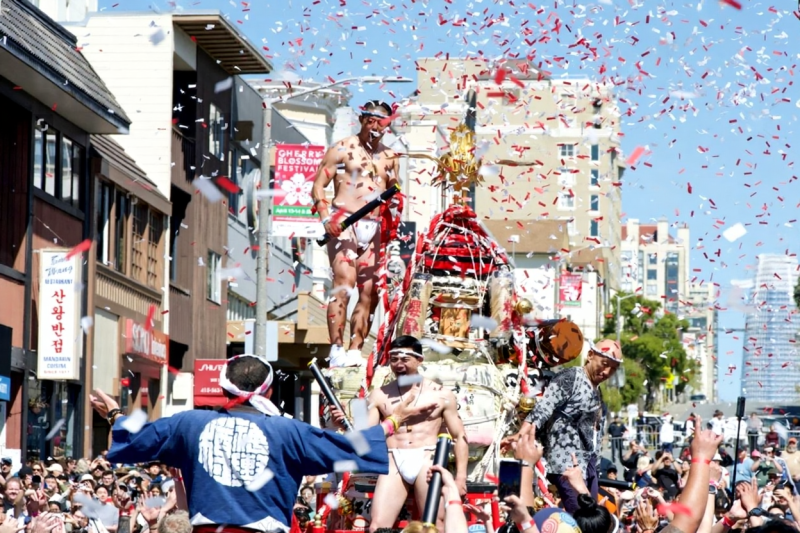
The parade’s incredible finale is the TaruMikoshi. This is a massive, ornate portable shrine weighing over 1,000 pounds, carried on the shoulders of over 100 chanting participants. It’s a powerful, energetic display of community spirit and a must-see spectacle.
Your Pre-Trip Checklist
A little preparation goes a long way in San Francisco.
Dress in Layers: This is the golden rule of SF. A chilly, foggy morning can become a sunny, breezy afternoon in an instant. A fleece or mid-layer under a windbreaker is the standard local uniform for a reason.
Comfortable Shoes: You will be walking. A lot. The hills are no joke. This is not the time to break in new shoes.
Portable Power Bank: Between navigating, taking photos, and using transit apps, your phone battery won’t stand a chance. A power bank is essential.
Cash: While most vendors take cards, the lines for ATMs are long and the smaller food stalls are often cash-only.
The Cherry Blossom Festival is one of the city's signature spring events. For a complete look at what's happening year-round, our complete guide to San Francisco Holidays: Bay Area Buzz is the essential next read for planning a trip around the city's top seasonal events.
An Unforgettable Bloom
San Francisco’s cherry blossom celebration offers something truly special: a world-class cultural event with the heart of a neighborhood block party. It’s a chance to not only witness the stunning beauty of spring but to feel the powerful spirit of a community that has refused to be erased.
By timing your visit strategically, knowing where to find your own quiet corner, and embracing the city’s public transit, you can bypass the stress and create a truly unforgettable memory. You’re no longer just a tourist; you’re an insider, ready to experience this beautiful and meaningful spectacle to its fullest.
Capture the Perfect Bloom
You’re going to take hundreds of photos of the cherry blossoms—don’t let them get lost on your camera roll. Our free collection of Travel Lightroom Presets is designed to make your photos pop with just one click. Transform your shots of the delicate pink petals and vibrant festival scenes into professional-quality images you’ll be proud to share.
Frequently Asked Questions (FAQ)
When is the absolute best time to see the cherry blossoms in San Francisco? While the festival is in mid-to-late April, the "best" time depends on what you want to see. For the most ethereal, classic blossoms in a garden setting, aim for the first week of April at the Japanese Tea Garden. For the full, vibrant festival experience with the fluffy Kwanzan blossoms, the second weekend of the festival is your best bet.
Is the Northern California Cherry Blossom Festival free? Yes, attending the festival in Japantown, including all the stage performances and watching the parade, is completely free. You will need to pay for food, drinks, and any items from craft vendors. Note that visiting the Japanese Tea Garden in Golden Gate Park requires a separate admission fee.
How much time should I budget for the festival? If you plan to eat, watch a few performances, and browse the stalls, give yourself at least 3-4 hours in Japantown. If you want to see the parade, plan for that to take an additional 2 hours of your day.
Is the festival kid-friendly? Absolutely. Kids love the energy, the food, and the parade. There are also often hands-on cultural activities like origami folding. However, the crowds can be overwhelming for small children, so a weekday visit or arriving right at the opening on a weekend is recommended.
Can I see cherry blossoms in San Francisco outside of Japantown and Golden Gate Park? Yes! Besides our "secret spot" at the Palace of Fine Arts, you can often find beautiful blooming trees scattered in residential neighborhoods like the Richmond and Sunset districts. Keep your eyes peeled in late March and April—you’ll be surprised where they pop up.
Recommended: Free Travel Lightroom Presets: The TrekGuider Wanderlust Collection
Recommended: NYC Photo Map: 25 Iconic and Hidden Spots
Travel News
Comments 0
No comments yet
Be the first to share your experience!
You May Also Like

Halloween SF: Haunts Without Horrors

SF Festivals: 7 Must-See Lineups

Christmas SF: Lights & Wharf Wonders

SF Pride: 6 Route & Party Hacks

Chinese New Year SF: Parade Essentials

San Francisco Holidays: Bay Area Buzz
TrekGuider @trekguider
Southwest Airlines Pulls Out of Chicago O'Hare and Washington Dulles

Southwest Airlines will end service at Chicago O'Hare International Airport and Washington Dulles International Airport on June 4, 2026, marking a significant network contraction for the Dallas-based carrier.
A company spokesperson described both exits as part of Southwest's "ongoing efforts to refine its network." The airline is in the middle of a broader transformation under CEO Bob Jordan that includes assigned seating, checked bag fees, and potential additions like first-class cabins and airport lounges.
The O'Hare departure closes a chapter that began in 2021 during a pandemic-era expansion. Performance there never met expectations, and Southwest already pulled back from four O'Hare markets in 2024. The airline holds three gates at the airport, which American and United — both aggressively expanding at ORD — may absorb.
Southwest remains the dominant carrier at Chicago Midway, operating more than 90% of departures there in 2026.
The Dulles exit ends roughly 20 years of service. Southwest's presence at IAD diminished steadily after it began flying from Reagan National in 2012 following the AirTran merger. Only the Denver route remained consistent.
The Metropolitan Washington Airports Authority expressed disappointment and hope that Southwest would eventually return.
Affected passengers can rebook at no cost. O'Hare travelers may switch to Midway, Indianapolis, or Milwaukee. Dulles passengers can choose Baltimore/Washington, Reagan National, Philadelphia, or Richmond. Full refunds are also available.
Travel News
Comments 0
No comments yet
Be the first to share your experience!
You May Also Like
Chicago Festivals: 8 Hidden Gems

Chicago Beer Fests: Top 6 Tastings

Christmas Chicago: 5 Market Musts

July 4th Chicago: Fireworks Hotspots

St. Patrick's: River Dyeing Secrets